-
Auxiliary verbs: do, be and have
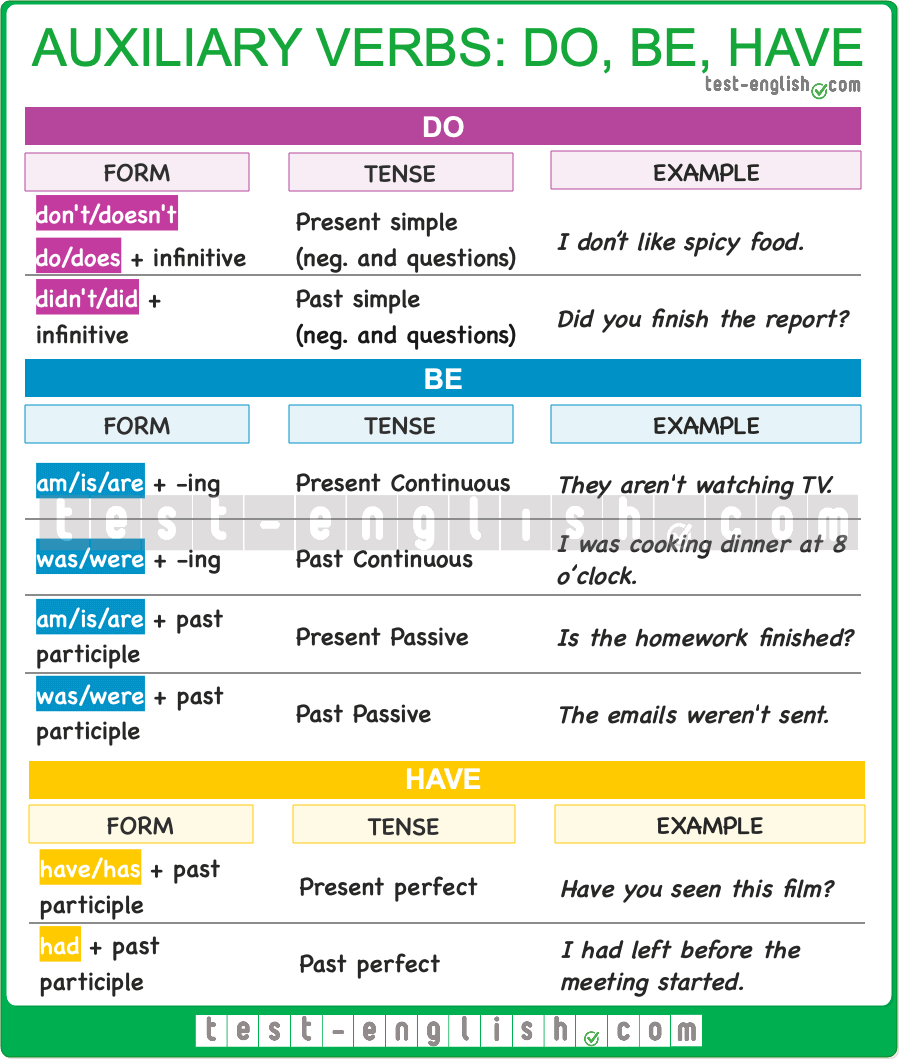
In English, there are three main auxiliary verbs: do, be and have. They have negative and question forms. Other verbs need an auxiliary to make these forms.
Modal verbs (can, could, may, might, must, should, will, would) are also auxiliary verbs.
Download full-size image from Pinterest
Be
Present and past continuous
We use be + –ing verb to form the present and past continuous.
We use am/is/are + -ing to form the present continuous.- She is reading a book.
- They aren’t watching TV.
- Are you studying for the test?
We use was/were + -ing to form the past continuous.
- I was cooking dinner at 8 o’clock.
- He wasn’t sleeping.
- Were they playing football?
Present and past simple passive
We use be + past participle to form the present and past simple passive.
We use am/is/are + past participle to form the present simple passive.
- English is spoken in many countries.
- The windows aren’t cleaned very often.
- Is the homework finished?
We use was/were + past participle to form the past simple passive.
- The match was cancelled.
- The emails weren’t sent.
- Were the tickets booked online?
Do
We use do/did + infinitive to make present and past simple negatives and questions.
We use don’t/doesn’t + infinitive to make present simple negatives, and do/does + subject + infinitive to make present simple questions.- I don’t like spicy food.
- She doesn’t work on Saturdays.
- Do they live near here?
We use didn’t + infinitive to make past simple negatives, and did + subject + infinitive to make past simple questions.
- We didn’t go to the party.
- He didn’t understand the question.
- Did you finish the report?
Have
We use have + past participle (worked, played, seen, etc.) to form the present and past perfect.
We use have/has + past participle to form the present perfect.- She has finished her homework.
- They haven’t visited the museum.
- Have you seen this film?
We use had + past participle to form the past perfect.
- I had left before the meeting started.
- She hadn’t studied for the exam.
- Had they arrived when you called?

-

Download lessons and tests as PDFs
Upgrade to PRO for printable PDFs and a more personalised learning experience.
- PDFs for every lesson and test
- An ad-free experience
- Progress tracking
- Skill badges
- Learner leaderboards

Watch the one-minute PRO overview
Exercises
Explanation
Downloads


