-
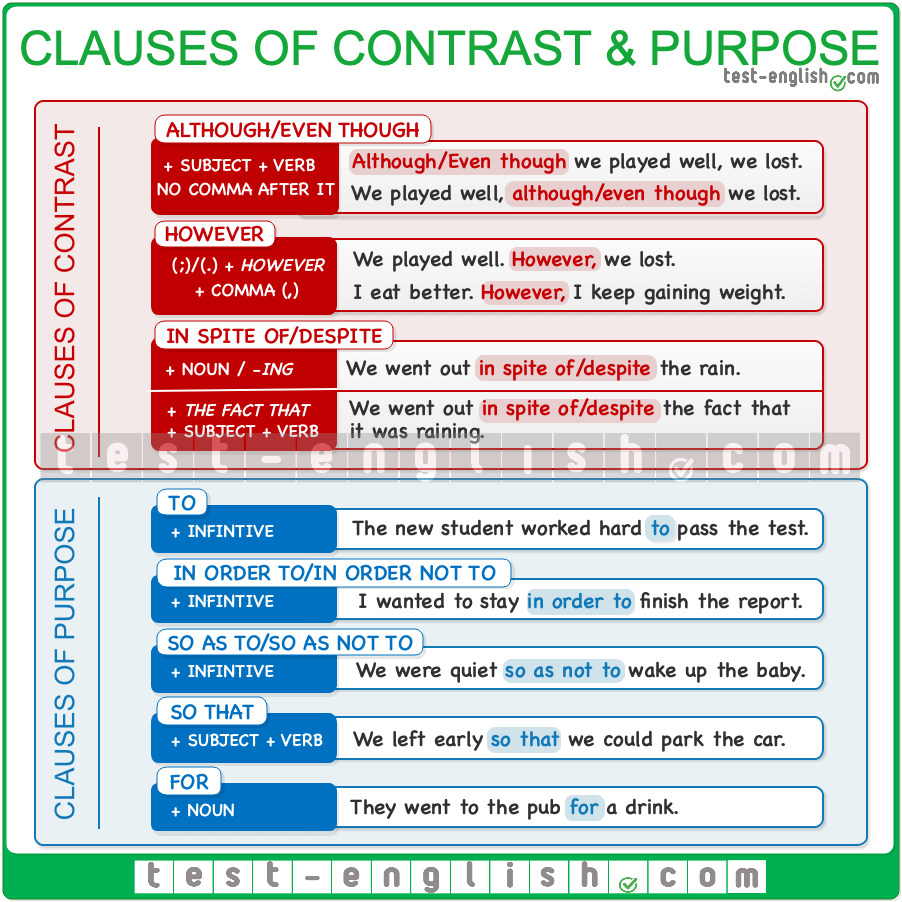
Clauses of contrast and purpose: Grammar chart
Download full-size image from Pinterest
Clauses of contrast
Although, even though
We can use although/even though at the beginning or in the middle of a sentence followed by a clause (subject + verb). We NEVER use a comma after although or event though.
- Although/Even though we had a bad game, we won.
- We won, although/even though we had a bad game.
However
We use however to connect two different sentences. We normally use however after a full stop (.) or a semi-colon (;). However should ALWAYS be followed by a comma.
- We didn’t like the hotel. However, we had a fantastic time.
- We went to the beach; however, the weather wasn’t perfect.
Despite/in spite of
Despite and in spite of are normally followed by a noun or a –ing verb. They can go at the beginning or in the middle of the sentence.
- Despite/In spite of the rain, we went to the concert.
- They arrived despite/in spite of leaving very early.
We can use a clause (subject + verb) after despite/in spite of + the fact that.
- We went out despite/In spite of the fact that it was raining.
Clauses of purpose
To + infinitive
The most common way to express purpose in English is to + infinitive.
- The student worked hard to pass the test.
In order to/so as to + infinitive
In order to or so as to + infinitive are more common in formal English, mainly in writing. The negative forms are in order not to and so as not to + infinitive.
- We were asked to stay in order to finish the project.
- He left home early in order not to be late.
- Use a plastic hammer so as to avoid damage.
- They walked quietly so as not to wake up the children.
So that + clause
We can also use so that + subject + verb to express purpose. We normally use a modal verb with this connector. (could, can, would, etc.)
- We left early so that we could park near the centre.
- He made some flashcards so that it would be easier for his mum to remember the instructions.
For + noun
We can also use for + noun to express purpose.
- We went to the bar for a drink.
- Would you like to go to the park for a run?

-

Download lessons and tests as PDFs
Upgrade to PRO for printable PDFs and a more personalised learning experience.
- PDFs for every lesson and test
- An ad-free experience
- Progress tracking
- Skill badges
- Learner leaderboards

Watch the one-minute PRO overview
Exercises
Explanation
Downloads


