Exercises
Explanation
Downloads
-
Adjectives in English – grammar chart
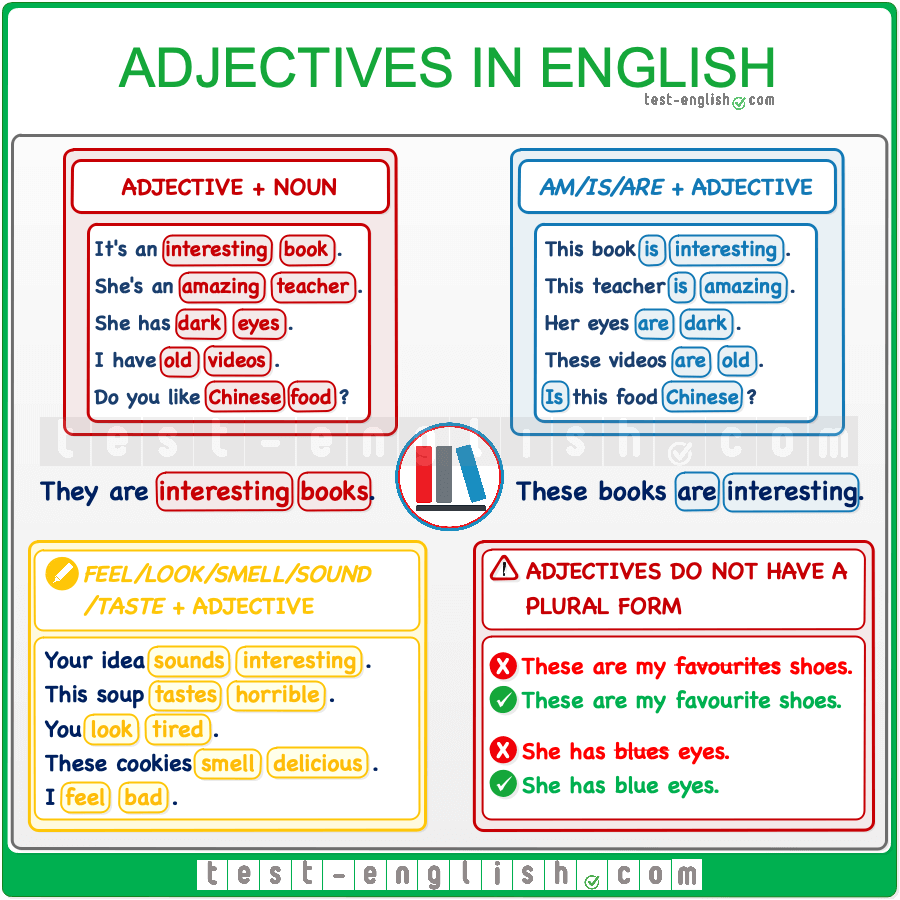
Download full-size image from Pinterest
Adjective + noun
When we use adjectives with a noun in English, the adjectives go before the noun.
- It’s an expensive guitar.

- It’s a guitar expensive.

- She has a new car.
- She has a car new.
Am/is/are + adjective
We can also use adjectives without a noun after the verb be.
- This guitar is expensive.
- Her car is new.
In questions, the adjective can go after be + subject.
- Is your car new?
- Are your classmates nice?
Feel/look/smell/sound/taste + adjective
We can also use adjectives without a noun after the verbs of the senses: feel, look, smell, sound, taste.
- Your idea sounds interesting.
- I don’t like this soup. It tastes horrible.
- You look tired.
- These cookies smell delicious.
- I feel depressed.
No plural
Adjectives in English have no plural. They are always singular.
- These are my favourite shoes.
- These are my favourites shoes.
- She has blue eyes.
- She has blues eyes.
Very/quite
We can use very and quite before the adjectives.
- It’s very expensive.
- It’s quite expensive.

- It’s an expensive guitar.
-

Download lessons and tests as PDFs
Upgrade to PRO for printable PDFs and a more personalised learning experience.
- PDFs for every lesson and test
- An ad-free experience
- Progress tracking
- Skill badges
- Learner leaderboards

Watch the one-minute PRO overview


