-
The subjunctive in English: present and past
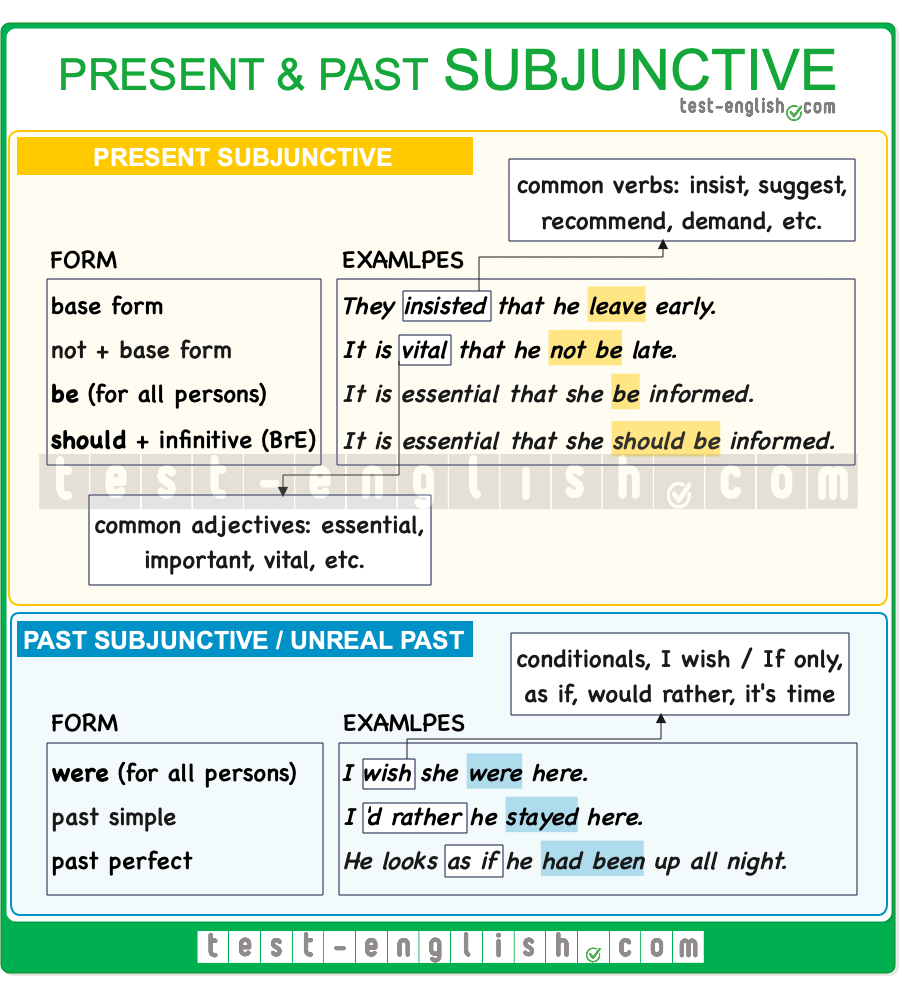
The subjunctive is used to talk about situations that are not presented as facts, such as demands, suggestions, advice, importance, or hypothetical situations.
There are two main types of subjunctive in English:- The present subjunctive is used mainly in formal language after certain verbs and adjectives
- The past subjunctive is used in hypothetical or unreal situations
Download full-size image from Pinterest
Present subjunctive
Form
The present subjunctive uses the base form of the verb (bare infinitive). This means that the verb does not add -s after he/she/it, and the verb be becomes be for all persons.
- They suggested that he leave early.
- It is essential that every member be present.
This structure is common in formal English. It is also more frequent in American English. In informal British English, speakers often use the present simple instead.
- They suggested that he leaves early.
- It is essential that every member is present.
For verbs other than be and persons other than he/she/it, the subjunctive looks the same as the present simple.
- They suggested that we leave early.
The negative of the present subjunctive is not + base form.
- They insisted that the report not include confidential information.
💡 In British English, the present subjunctive is often replaced by should + infinitive.- They suggested that he should leave early.
- It is essential that every member should be present.
This structure is common in both formal and neutral styles.
Use
The present subjunctive is mainly used in that-clauses after certain verbs and adjectives to express requests, demands, recommendations, suggestions, or necessity.
Common verbs: advise, ask, demand, insist, order, propose, recommend, request, suggest
- The committee recommended that the report be revised.
- The doctor suggested that he stop smoking.
Common adjectives: advisable, crucial, essential, important, obligatory, (un)necessary, urgent, vital
- It is essential that every member be informed.
- It is important that she arrive on time.
🔍 Fixed expressions
The present subjunctive also appears in a few fixed idiomatic expressions such as: Be that as it may, Come what may, Suffice it to say, God save the King, etc.‣ Be that as it may, we must continue with the plan.
‣ Come what may, we will support you.
‣ Suffice it to say that the negotiations were difficult.Past subjunctive
Form
The past subjunctive uses past verb forms to express hypothetical or unreal situations in the present or future.
The only verb with a distinct past subjunctive form is be. In hypothetical situations, were is used with I/he/she/it.- If I were you, I would apologise.
- I wish she were here.
With other verbs, the form is identical to the past simple, so there is no difference in form between the past simple and the subjunctive.
- If I knew the answer, I would tell you.
- I wish I had more time.
In informal or spoken English, was is often used instead of were with I/he/she/it.
- If I was rich, I’d travel the world.
- I wish she was here.
However, the expression If I were you is almost always used, even in informal English.
Use
The past subjunctive is used to talk about present or future hypothetical or unreal situations. This use of past forms is called the unreal past, and it is very common in the following five structures:
1️⃣ Conditionals
The past subjunctive is used in second conditional sentences to talk about hypothetical or unreal situations in the present or future.
- If I knew the answer, I would tell you.
- If I were you, I would apologise.
2️⃣ I wish / If only
We use the past subjunctive after I wish / If only to express regret or a desire for a different present situation.
- I wish I had more time.
- If only she were here.
3️⃣ would rather / would sooner
We use past forms after would rather / would sooner when talking about another person’s actions.
- I’d rather you stayed here.
- She’d sooner he took the train.
4️⃣ as if / as though
Past forms are used after as if and as though to describe imaginary or unreal situations.
- He talks as if he knew everything.
- She looks as though she were tired.
5️⃣ It’s time
We use past forms after it’s time to say that something should happen now or very soon.
- It’s time you went home.
- It’s time we started the meeting.
🔍 When the hypothetical or unreal situation refers to the past, we use the past perfect.‣ If I had known, I would have told you.
‣ I wish I had studied harder.
-

Download lessons and tests as PDFs
Upgrade to PRO for printable PDFs and a more personalised learning experience.
- PDFs for every lesson and test
- An ad-free experience
- Progress tracking
- Skill badges
- Learner leaderboards

Watch the one-minute PRO overview
Exercises
Explanation
Downloads


