-
Advanced participle clauses
Participle clauses allow us to express ideas such as time, reason, condition and result in a more concise way. They are particularly common in written English and can make sentences sound more varied and sophisticated.
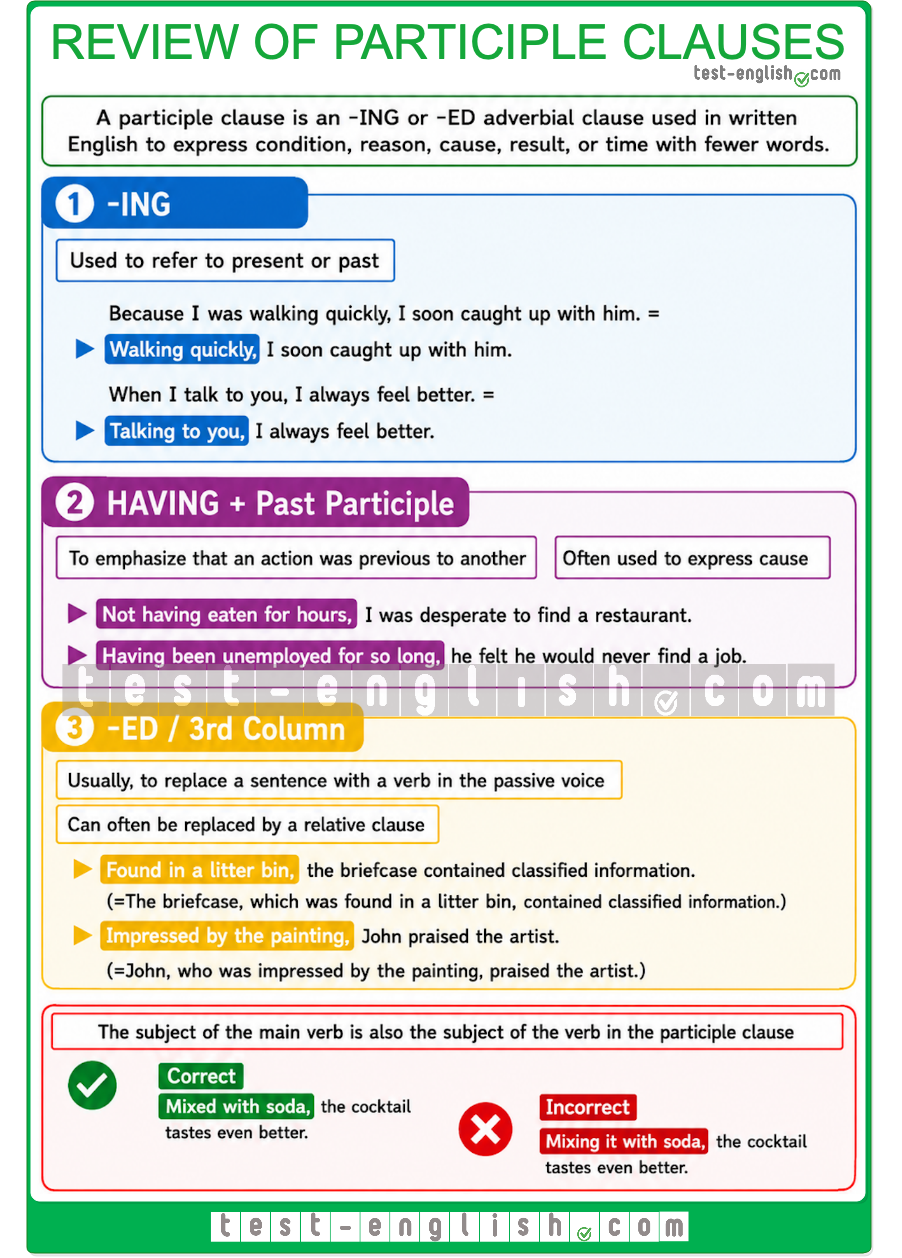
As explained in our B2 lesson on participle clauses, we can use different participle forms depending on the meaning we want to express.Participle clauses: A quick review
We use -ing participle clauses when the meaning is active.
- Knowing that she was late, she called a taxi.
- Walking through the park, I found a wallet.
We use having + past participle when the action in the participle clause happened before the action in the main clause.
- Having finished the report, he went home.
- Not having eaten all day, I was starving.
The passive form is having been + past participle.
- Having been warned about the risks, they proceeded carefully.
We use past participle clauses when the meaning is passive or when we describe a resulting state.
- Built in the nineteenth century, the house is now protected.
- Located near the station, the hotel is easy to reach.
Participle clauses can follow conjunctions such as when, while, after, before, although and if, as well as prepositions such as on, without and after.
- When crossing the road, students must be very careful.
- On arriving at the hotel, we discovered that our room was not ready.
Normally, the participle clause and the main clause must refer to the same subject.
- Walking home, I saw an accident.

- Walking home, an accident happened.

Here’s a chart summarising the main points from the review:
Download full-size image from Pinterest
In this lesson, we will look at more advanced structures, including participle clauses with their own subject, clauses introduced by with, and participle expressions that comment on a whole sentence.
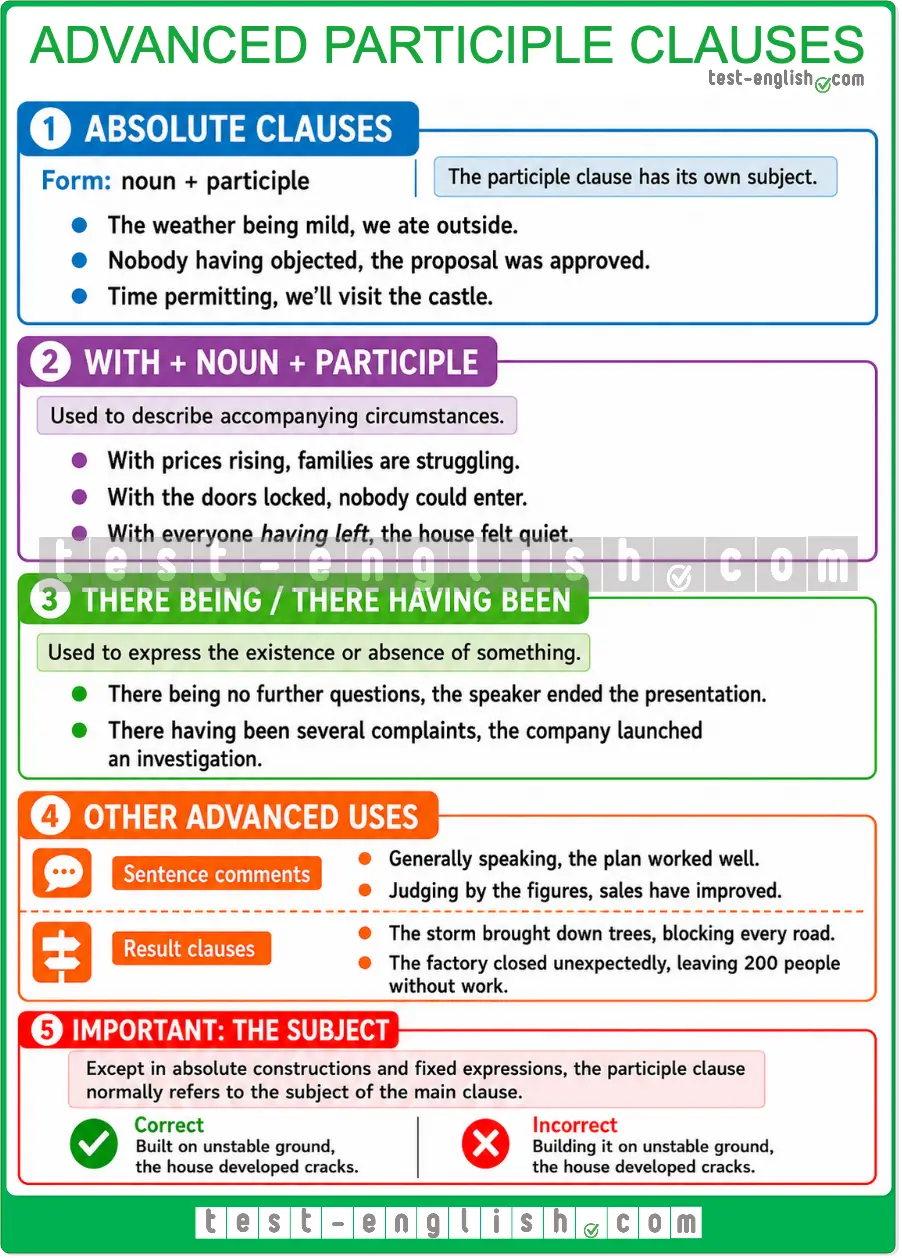
Absolute participle clauses
As we have seen, a participle clause normally has the same subject as the main clause. However, in more formal English, an absolute participle clause can have its own subject.
- The weather being unusually warm, we decided to eat outside.
- Nobody having objected, the proposal was approved.
In these sentences, the subject of the participle clause is different from the subject of the main clause:
- The weather was unusually warm, so we decided to eat outside.
- Nobody had objected, so the proposal was approved.
We can use different participle forms depending on the relationship we want to express:
- Time permitting, we will visit the castle. (if time permits)
- The door left unlocked, anyone could have entered. (because the door was left unlocked)
- The last train having departed, we had to take a taxi. (because the last train had departed)
Absolute participle clauses are mainly used in formal writing and are less common in everyday conversation. They can express ideas such as reason, condition, time or circumstance.
Absolute clauses with there
We can use there being in an absolute participle clause to describe the existence or absence of something. It often corresponds to a clause beginning with because there is/was or as there is/was.
- There being no further objections, the chairperson closed the meeting. (As there were no further objections…)
- There being very little time left, we went straight to the final item. (Because there was very little time left…)
We can use there having been when the situation existed before the action in the main clause.
- There having been several complaints, the company launched an investigation.
With-absolute constructions
We can also introduce an absolute construction with with. The pattern with + noun + participle describes a situation or circumstance accompanying the action in the main clause.
We use an -ing participle when the meaning is active or when an action is in progress:- With prices continuing to rise, many families are struggling to save money.
- With everyone watching, he became increasingly nervous.
We use a past participle when the meaning is passive or when we describe a resulting state:
- With the doors locked, nobody could enter the building.
- With all the preparations completed, the event could finally begin.
We can also use a perfect participle to make it clear that one action was completed before another:
- With everyone having left, the house felt unusually quiet.
The noun after with is the subject of the participle clause:
- Prices are continuing to rise.
- The doors were locked.
- Everyone had left.
Advanced uses and common problems
Commenting on the whole sentence
Some participle expressions comment on the whole sentence rather than describing the action of the main subject. Many of these are fixed expressions.
- Generally speaking, people are more productive in the morning.
- Judging by his reaction, he had not expected the news.
- Considering the circumstances, they handled the situation remarkably well.
Because these expressions comment on the whole sentence, they do not need to have the same subject as the main clause.
Participle clauses expressing result
An -ing participle clause placed after the main clause can describe a consequence of the situation described in the main clause.
- The storm brought down several trees, blocking every road into the village.
- The company closed three offices, leaving hundreds of people without work.
The result is normally a direct consequence of the action in the main clause.
Avoiding dangling and ambiguous participles
Except in absolute constructions and fixed sentence-commenting expressions, the understood subject of a participle clause should normally be the subject of the main clause.
- Walking into the room, the painting immediately caught my attention. (The painting was not walking.)
- Walking into the room, I immediately noticed the painting.
We should also avoid structures in which it is unclear who is performing the action.
- Having discussed the problem with Marta, Daniel’s objections seemed less convincing.
- Having discussed the problem with Marta, I found Daniel’s objections less convincing.
Here’s a chart summarising the main points from the lesson:
Download full-size image from Pinterest

-

Download lessons and tests as PDFs
Upgrade to PRO for printable PDFs and a more personalised learning experience.
- PDFs for every lesson and test
- An ad-free experience
- Progress tracking
- Skill badges
- Learner leaderboards

Watch the one-minute PRO overview
Exercises
Explanation
Downloads


