-
Advanced modal verbs: will, would and should
In this lesson, you will learn advanced uses of the modal verbs will, would and should, including habits, criticism, assumptions, deductions and expectation.
Will
Download full-size image from Pinterest
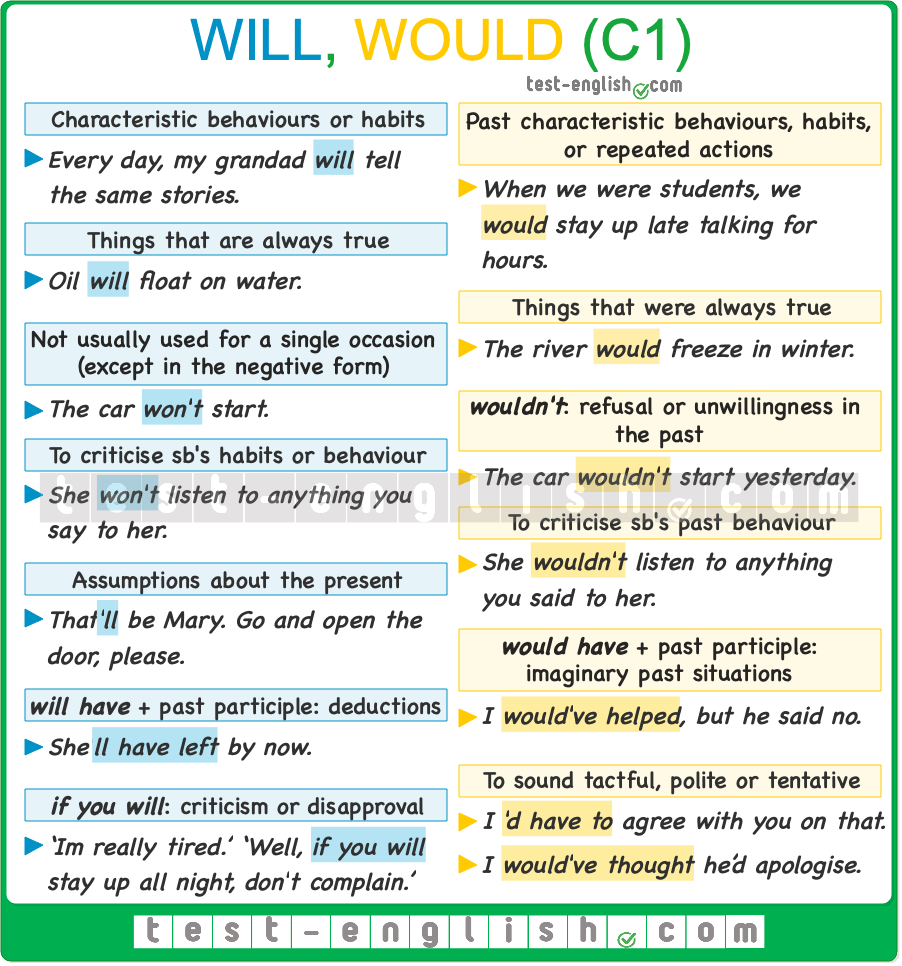
We don’t only use will to talk about the future: it can also express habits, typical behaviour, assumptions and deductions. Here are some common advanced uses of will.
🔹 Characteristic behaviours or habits (often with adverbs of frequency).- Whenever we visit my grandparents, my grandad will tell the same stories.
🔹 Things that are always true.
- Oil will float on water.
🔹 Not used in this way to talk about a specific occasion (except in the negative form, where it can be used this way).
- The car won’t start.
🔹 To criticise someone’s annoying habits or common behaviour.
- He will leave everything until the last minute.
- She won’t listen to anything you say to her.
🔹 To make assumptions about the present.
- That‘ll be Mary. Go and open the door, please.
- Don’t phone him now. He‘ll be having dinner.
🔹 We can use will have + past participle to make deductions about the past (to say what we believe probably happened).
- He will have forgotten about the meeting.
- She‘ll have left by now.
🔹 We can use if you will to express criticism or disapproval. This use is formal and not very common.
- ‘Im really tired.’ ‘Well, if you will stay up all night playing video games, you can’t complain.’
Would
Many advanced uses of would are similar to will, but they are used to talk about the past or to express more tentative, polite opinions. Here are some common advanced uses of would.
🔹 To talk about past characteristic behaviours, habits or repeated actions (often with adverbs of frequency).- My dad would always fall asleep on the sofa.
- When we were students, we would stay up late talking for hours.
🔍 Note: We can also use used to to describe past habits or repeated actions. However, we can only use would with dynamic verbs and when the time reference is clear. In other cases, only used to is possible.
‣ As a child, I used to be very shy. (NOT: would)
‣ I used to walk to school. (NOT: would, because the time reference isn’t established)
‣ When we lived in London, we would (or used to) take long walks along the river. (= repeated action)🔹 Things that were always true in the past (with a clear past time reference).
- Back then, people would write letters instead of sending emails.
- In those days, the river would freeze every winter.
🔹 Refusal or unwillingness in the past (negative form: wouldn’t).
- The car wouldn’t start this morning.
- I tried to explain, but he wouldn’t listen.
🔹 To criticise someone’s past annoying habits or behaviour.
- He would leave everything until the last minute and then blame other people.
- She would interrupt everyone as if her opinion was the only one that mattered.
🔹 We can use would have + past participle to talk about an imaginary past situation (something that could have happened, but didn’t happen).
- I would have helped you, but I didn’t know you needed anything.
- They would have arrived earlier if there hadn’t been so much traffic.
🔹 To sound more tactful or polite, or to express a tentative opinion.
- I‘d say it’s worth waiting a bit longer before making a decision.
- I‘d have to agree with you on that.
- I would have thought he’d at least apologise.
Should
Download full-size image from Pinterest
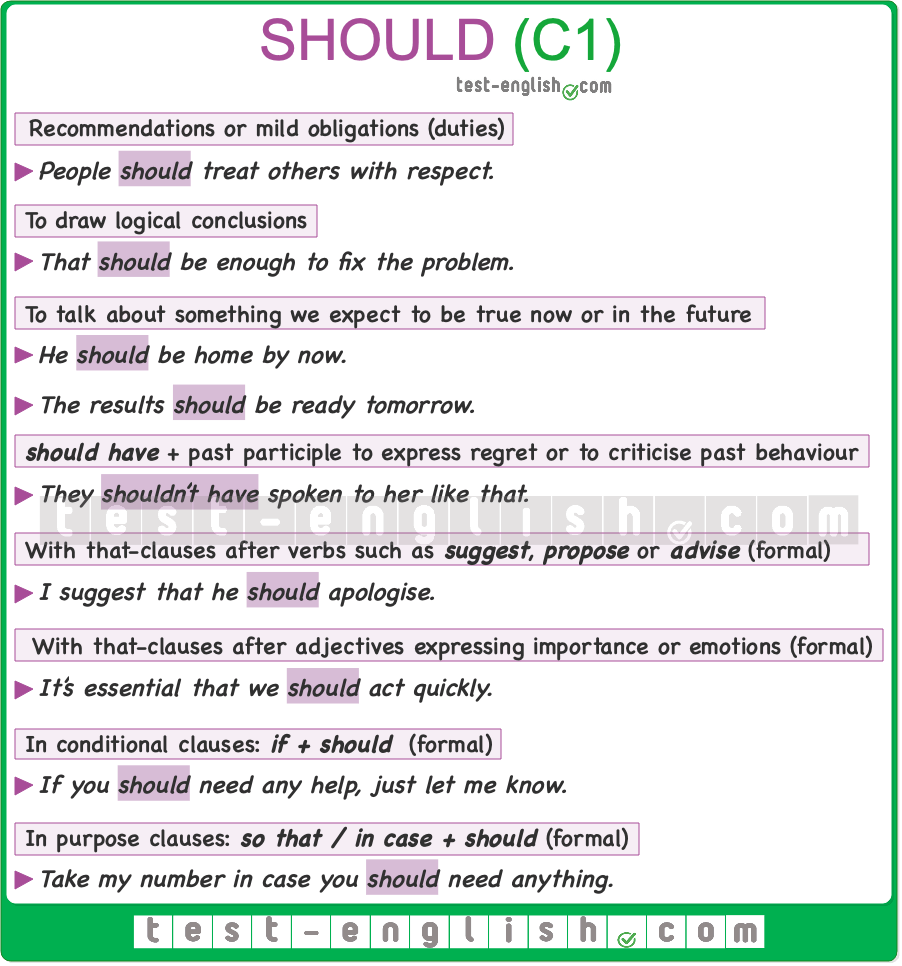
We use should not only to give advice: it can also express expectation, logical conclusions, criticism and more formal structures. Here are some common advanced uses of should.
🔹 To talk about recommendations or mild obligations (duties).- You should apologise to her.
- People should treat others with respect.
🔹 To draw logical conclusions.
- That should be enough to fix the problem.
- This should solve the issue.
🔹 To talk about something we expect to be true now or in the future.
- He should be home by now.
- The results should be ready tomorrow.
🔹 We use should have + past participle to express regret or to criticise past behaviour.
- You should have told me earlier.
- They shouldn’t have spoken to her like that.
🔹 With that-clauses after certain verbs such as suggest, propose or advise (formal, especially in British English).
- I suggest that he should apologise.
- They recommended that we should book in advance.
🔹 With that-clauses after adjectives expressing importance or emotions (formal, especially in British English).
- It’s essential that we should act quickly.
- I’m surprised that she should say something like that.
🔹 In conditional clauses (formal): if + should.
- If you should need any help, just let me know.
- If anything should go wrong, call me immediately.
🔍 Note: In formal English, we can invert the subject and verb instead of using if.
‣ Should you need any help, just let me know. (= If you should need any help…)
‣ Should anything go wrong, call me immediately. (= If anything should go wrong…)🔹 In purpose clauses (formal): so that / in case + should.
- We left early so that we shouldn’t miss the train.
- Take my number in case you should need anything.

-

Subscribe to enjoy PDF downloads!
Subscribe to our PRO platform to enjoy all these extra features:
- PDF downloads of all lessons and tests
- Improved design with no ads
- Track your progress
- Level badges for every skill
- Leaderboards to compete with other learners
Exercises
Explanation
Downloads


