-
Pretty, Rather, Quite, Fairly
Download full-size image from Pinterest
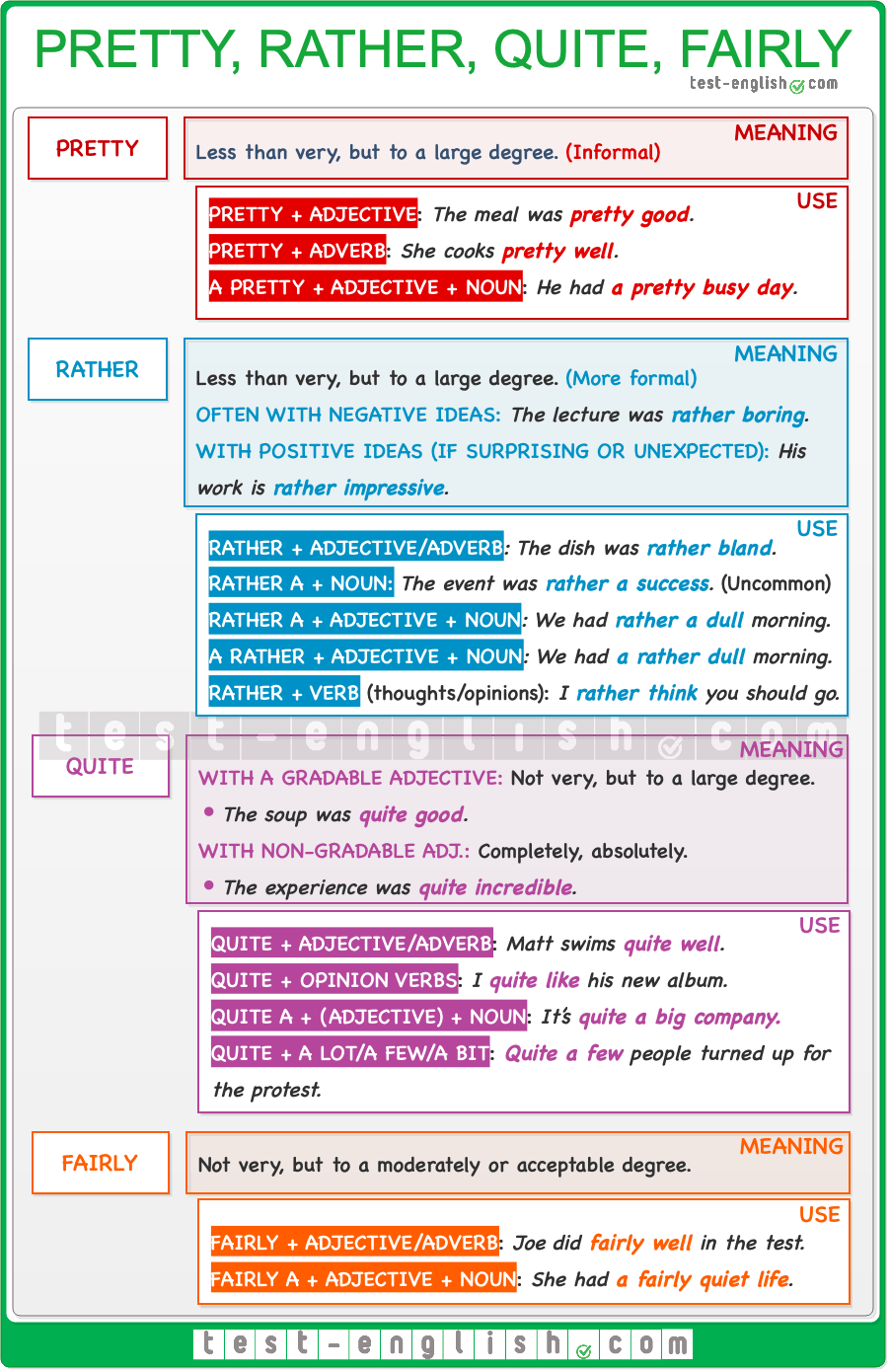
The words pretty, quite, rather, and fairly are all intensifiers. We use them to modify the intensity of the adjective, adverb, verb, or noun that comes after them. Though their meanings can seem relatively similar, each word has its own specific uses and can, therefore, be used in its own particular way.
Pretty
Pretty, meaning ‘less than very, but to a large degree’, can only be used before adjectives and adverbs. It is used in informal language only and rarely in negative contexts.
- The meal was pretty good.
- She cooks pretty well.
When pretty is used to modify an adjective + noun, we always put an article in front of it.
- We had a pretty busy day.
- He’s a pretty good driver.
Rather
Rather has a similar meaning to pretty, but it’s more formal. It is a versatile intensifier with several different uses.
It is often used to add intensity to a negative idea.- The dish was rather bland.
- The lecture was rather boring.
Rather can also be used to emphasise positive ideas when something is unusual or surprising.
- His work is rather impressive.
When used to modify a noun, rather is followed by an article. This, however, is not particularly common.
- The event was rather a success, I believe.
When used before an adjective + noun, the article can be placed before or after the word rather.
- We’ve had rather a dull morning. (more formal)
- We’ve had a rather dull morning.
Rather can also be used before verbs to express thoughts or emotions. This is more common in British English than in American English.
- I rather think you should apologise to him.
Quite
Quite is another versatile adverb of degree. It usually has two different meanings depending on the word that comes after it.
When quite is used before gradable adjectives and adverbs, it means ‘less than very, but to a large degree’. A gradable adjective is an adjective that can have different levels of that quality; for example, the word good can accept the distinction between a little good and very good. The negative not quite can be used in the same way to mean ‘not completely’.- The soup was quite good.
- Matt swims quite well.
- My hair is not quite dry.
When quite is used before non-gradable adjectives such as sure, certain, amazing, awful, etc. it means ‘completely’, ‘absolutely’. Non-gradable adjectives are extreme adjectives that cannot be qualified by words such as a little or very.
- I’m quite sure that is the correct answer.
- The experience was quite incredible.
Quite can also be used to intensify opinion verbs such as like, agree, and enjoy.
- I quite like his new album.
- We quite enjoyed playing in the rain.
Before a noun or an adjective + noun, quite is always followed by an article.
- The book launch was quite a success.
- It’s quite a big company.
Quite can also be used before the particles a few, a lot, and a bit to indicate a larger quantity of something.
- Quite a few people turned up for the protest.
- The weather in Italy is quite a lot warmer than it is here.
Fairly
Fairly, meaning ‘not very, but to a moderate or acceptable degree’, is the weakest in intensity of the four words. It can go before adjectives and adverbs.
- We live fairly close to one another. Just a 10-minute drive away.
- Joe did fairly well in the test. He could have done better, though.
When used before adjective + noun, the article is placed before fairly.
- It is a fairly common surname where she lives.
- She had a fairly quiet life.

-

Download lessons and tests as PDFs
Upgrade to PRO for printable PDFs and a more personalised learning experience.
- PDFs for every lesson and test
- An ad-free experience
- Progress tracking
- Skill badges
- Learner leaderboards

Watch the one-minute PRO overview
Exercises
Explanation
Downloads


