-
C1 advanced linking words and phrases
In our B2 lesson on clauses of contrast, purpose, reason and result, we use familiar linkers such as although, because, due to, so that and therefore. Our B2 lesson on discourse markers covers other ways of connecting and organising ideas. In this lesson, we will focus on a wider range of precise and often more formal ways of expressing cause, justification, concession, result and purpose.
Download full-size image from Pinterest
Cause, reason and justification
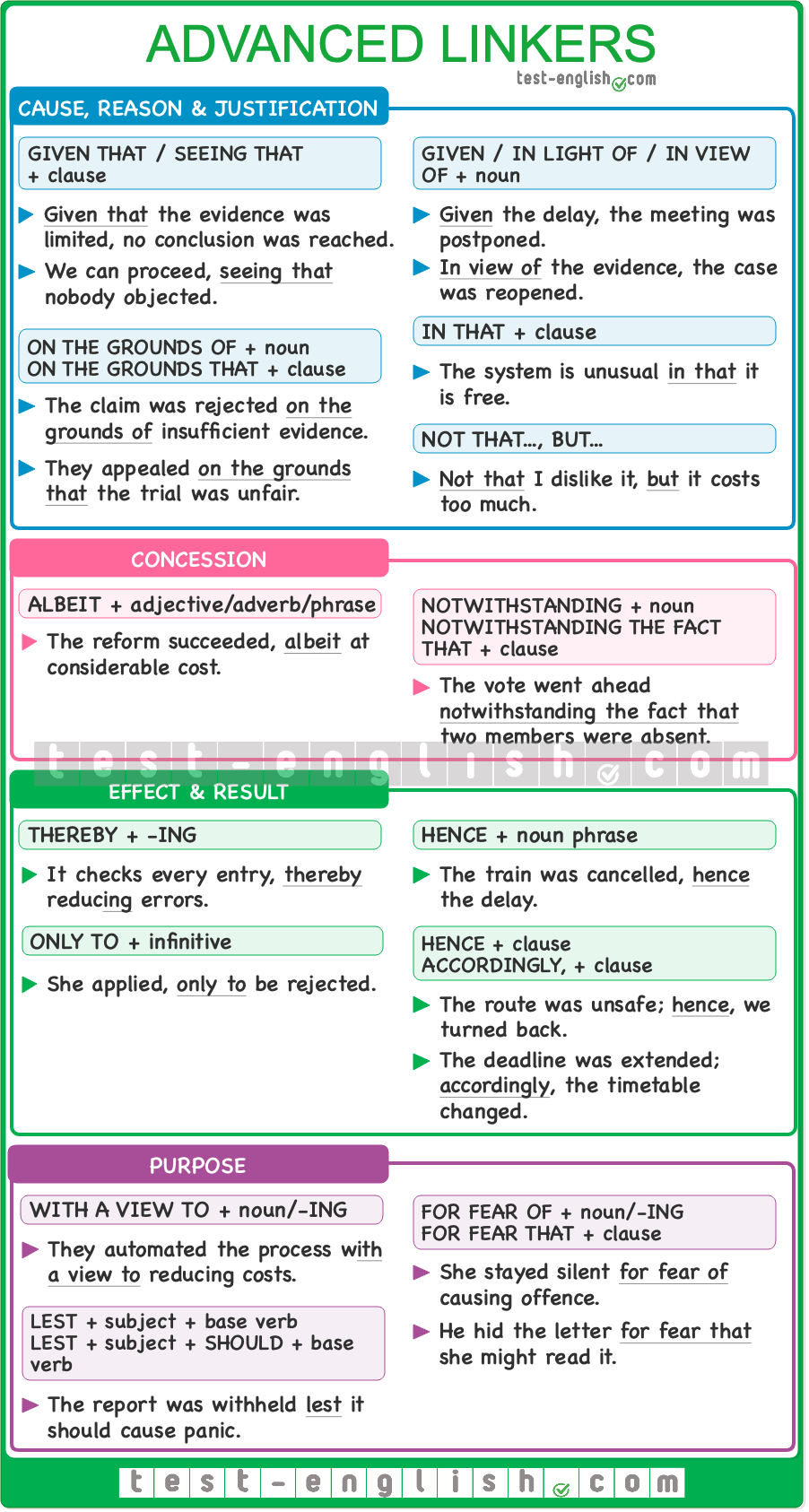
Given that and seeing that + clause
Both expressions introduce a fact that we should take into consideration. They are followed by a clause. Seeing that is less formal than given that and is often similar to because or since.
- Given that the survey covered only a small sample, its findings should be treated with caution.
- Seeing that nobody has raised an objection, we can proceed to a vote.
Given, in light of and in view of + noun phrase
These expressions mean ‘taking something into consideration’. They are followed by a noun phrase. In light of and in view of are more formal than given. Before a clause, we use given that or in light of/in view of the fact that.
- Given the limited evidence, no firm conclusion can be reached.
- In light of recent developments, the policy will be reviewed.
- In view of the fact that no objections were submitted, the proposal was approved.
The examples above show these linking structures before the main clause, but they can also come after it. When the linking clause or phrase comes first, it is normally followed by a comma.
- We can proceed to a vote seeing that nobody has raised an objection.
On the grounds of and on the grounds that
These expressions introduce the reason offered to justify an action, decision or opinion. We use on the grounds of + noun phrase and on the grounds that + clause. They are particularly common in official, legal and formal contexts. They usually follow the action or decision they justify, but they can also come before the main clause.
- The application was rejected on the grounds of insufficient evidence.
- On the grounds that the procedure had been unfair, they challenged the decision.
In that
In that + clause explains why or in what way the previous statement is true. It is more precise than a general reason introduced by because and is mainly used in formal English. It normally follows the statement it explains and is not generally used at the beginning of a sentence.
- The arrangement is unusual in that it allows users to remain anonymous.
- Her account was misleading in that it omitted a crucial detail.
Not that … but …
We use not that … but … to reject a possible explanation and introduce the real one. The second part may begin with but, but rather or but because, depending on its structure. This structure normally follows an initial statement, but it can also begin a sentence when the context is already clear.
- I declined, not that I doubted the project, but because I lacked the time.
- The plan is problematic, not that its aims are unreasonable, but rather that its costs have been underestimated.
- ‘Why did you reject the offer?’ ‘Not that I disliked it, but I wasn’t prepared to travel so much.’
Concession
Albeit
Albeit is a formal and concise alternative to although. It normally introduces an adjective, adverb, prepositional phrase or participle phrase rather than a complete clause with its own subject and verb. It usually comes after the main statement and is often preceded by a comma.
- The reform was successful, albeit considerably more expensive than expected.
- The committee accepted the findings, albeit with several reservations.
Notwithstanding
Notwithstanding means ‘despite’ and is mainly used in formal or legal English. It can precede a noun phrase or the fact that + clause. In very formal writing, it may also follow the noun phrase.
- Notwithstanding several technical difficulties, the launch went ahead as planned.
- The committee approved the proposal notwithstanding the fact that the evidence was incomplete.
- The initial objections notwithstanding, the board approved the merger.
Effect and result
Thereby + -ing
Thereby + -ing introduces the direct result of the action in the main clause. It means ‘in this way’ or ‘as a result of doing so’ and is common in formal explanations of processes, policies and consequences. This -ing clause normally follows the action that produces the result and is usually separated from the main clause by a comma.
- The system checks every entry automatically, thereby reducing the risk of human error.
- The company published the complete dataset, thereby allowing independent researchers to verify the findings.
Only to + infinitive
Only to + infinitive introduces an unexpected and often disappointing result. Despite its infinitive form, it describes what happened next, not the purpose of the previous action. The only to clause follows the action whose unexpected result it describes and is normally preceded by a comma.
- She spent months negotiating the agreement, only to have it rejected at the final meeting.
- The researchers repeated the experiment twice, only to obtain the same inconclusive result.
Hence and accordingly
Hence introduces a consequence. It is a formal way of saying ‘for this reason’ or ‘therefore’. It can be followed directly by a noun phrase or introduce a complete clause. Accordingly introduces a logical or appropriate consequence and is followed by a complete clause.
When hence and accordingly introduce a complete clause, they normally appear after a full stop or semicolon. Accordingly is normally followed by a comma, and we may also use a comma after hence before a complete clause, but not when hence is followed directly by a noun phrase.- The permit had expired, hence the refusal to renew the contract.
- The evidence was incomplete; hence, further investigation was required.
- The deadline was extended; accordingly, the timetable was revised.
Purpose
With a view to + noun/-ing
With a view to + noun/-ing expresses the intended purpose of an action, especially when the aim is expected to be achieved in the future. It means ‘with the intention of’. The word to is a preposition here, so it is followed by a noun or an -ing form, not an infinitive.
This phrase can appear before or after the main clause. When it comes first, it is normally followed by a comma.- With a view to encouraging smaller businesses to apply, the council amended the rules.
- Both sides resumed negotiations with a view to reaching a permanent settlement.
For fear of, for fear that and lest
These expressions introduce a negative purpose: an action is taken to prevent an undesirable consequence. We use for fear of + noun/-ing and for fear that + clause. Lest is a formal equivalent of for fear that and means ‘to prevent the possibility that’. It is followed by a clause containing a base verb or, particularly in British English, should + base verb. These structures normally follow the clause describing the action taken to avoid the unwanted result. They can also come first, in which case they are normally followed by a comma.
- For fear of causing unnecessary alarm, officials withheld the details.
- She avoided naming the source for fear that doing so might place the source at risk.
- The company delayed the announcement lest it trigger a sudden fall in share prices.
- The company delayed the announcement lest it should trigger a sudden fall in share prices.
As lest already expresses a negative purpose, we do not normally use not in the clause that follows it.
🔍 Many of these linking words and phrases are formal. In everyday conversation, simpler alternatives such as because, although, so and to are often more natural.
Exercises
Explanation
Downloads