-
Word formation: suffixes
In this Advanced Vocabulary lesson, you will learn common suffixes used to form nouns and adjectives. A suffix is a letter or group of letters added to the end of a base word. It can change the word’s meaning, its word class or both.
The process of forming a noun from another word is known as nominalisation. Adding a suffix may also cause changes to the spelling or pronunciation of the base word.
Noun-forming suffixes
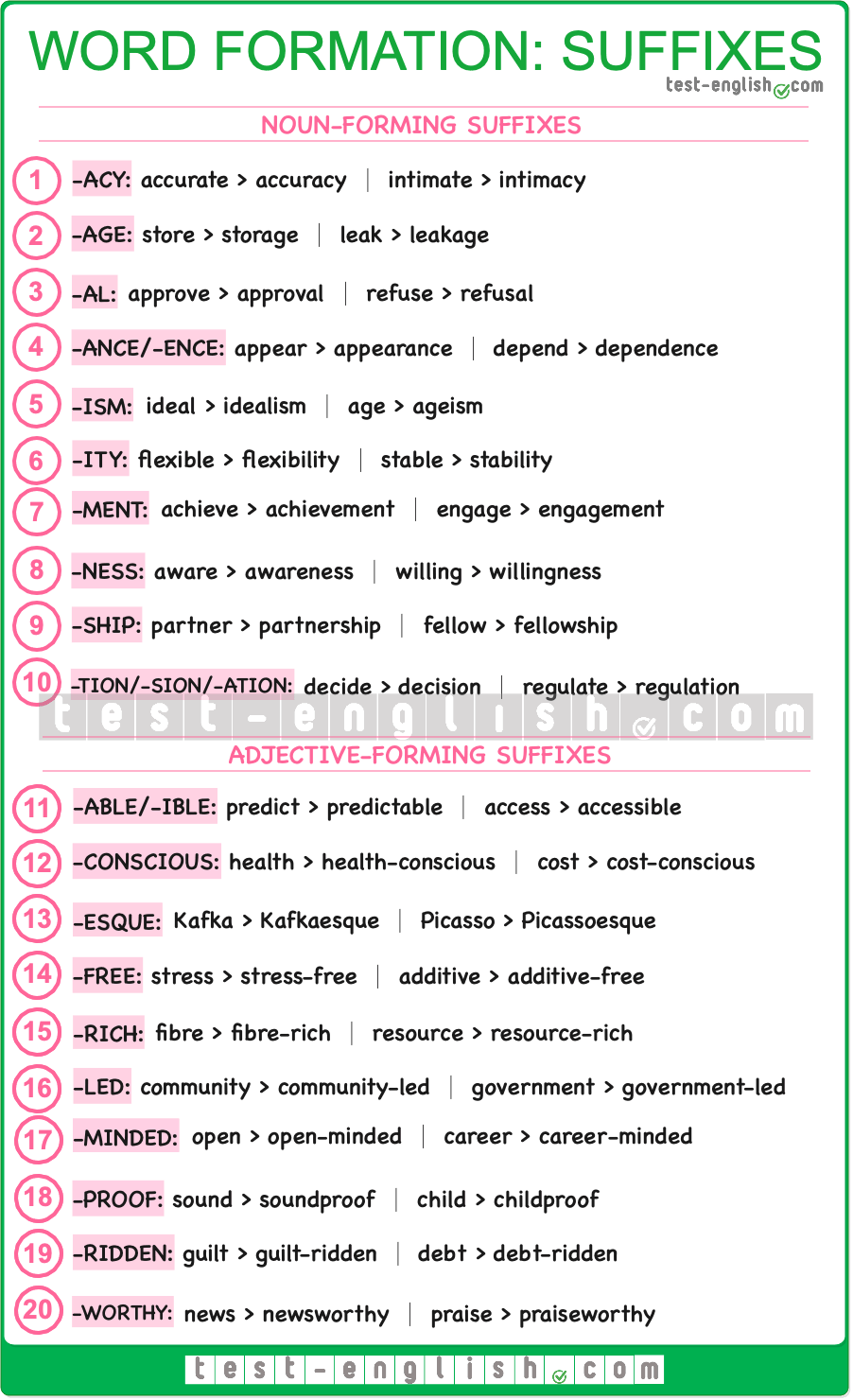
Suffix Examples -acy accuracy, privacy, intimacy -age storage, leakage, breakage -al approval, refusal, arrival -ance/-ence appearance, dependence, competence -ism capitalism, idealism, ageism -ity equality, flexibility, stability -ment development, achievement, investment -ness awareness, willingness, effectiveness -ship partnership, membership, leadership -tion/-sion/-ation decision, expansion, regulation Meanings and examples
1 -acy: mainly adjective → noun, referring to a state or quality.
- The investigation raised doubts about the accuracy of the measurements.
2 -age: verb/noun → noun, referring to an activity, result, amount or collection.
- The archive does not have sufficient storage for all its records.
3 -al: verb → noun, referring to an action or result.
- The project cannot begin without the committee’s formal approval.
4 -ance/-ence: verb/adjective → noun, referring to an action, state or quality.
- The region’s dependence on imported fuel has increased considerably.
5 -ism: noun/adjective → noun, referring to a belief, system, attitude or practice.
- The campaign aims to challenge ageism in recruitment.
6 -ity: adjective → noun, referring to a state or quality.
- One advantage of the position is the flexibility it offers employees.
7 -ment: mainly verb → noun, referring to an action, process, result or state.
- The organisation invests heavily in the professional development of its staff.
8 -ness: adjective → noun, referring to a state or quality.
- The initiative was designed to increase public awareness of online fraud.
9 -ship: noun → noun, referring to a relationship, status, position or skill.
- The two universities have formed a research partnership.
10 -tion/-sion/-ation: verb → noun, referring to an action, process or result.
- The rapid expansion of the programme created several logistical problems.
Adjective-forming suffixes
Suffix Examples -able/-ible predictable, manageable, accessible -conscious health-conscious, safety-conscious, cost-conscious -esque Kafkaesque, Picassoesque, statuesque -free stress-free, tax-free, additive-free -rich fibre-rich, protein-rich, resource-rich -led community-led, student-led, government-led -minded open-minded, like-minded, career-minded -proof waterproof, soundproof, childproof -ridden guilt-ridden, crime-ridden, debt-ridden -worthy newsworthy, praiseworthy, trustworthy Meanings and examples
11 -able/-ible: mainly verb → adjective, meaning that something can be done.
- The long-term consequences of the policy are not entirely predictable.
12 -conscious: noun → adjective, meaning aware of or concerned about something.
- The company has become increasingly cost-conscious as its profits have declined.
13 -esque: name/noun → adjective, meaning similar in appearance, character or style.
- The endless forms and contradictory instructions made the process seem Kafkaesque.
14 -free: noun → adjective, meaning without something.
- Demand for additive-free food has risen steadily.
15 -rich: noun → adjective, meaning containing a large amount of something.
- A fibre-rich diet can help maintain a healthy digestive system.
16 -led: noun/adjective → adjective, meaning controlled, organised or influenced by someone or something.
- A community-led initiative helped restore the neglected public gardens.
17 -minded: noun/adjective → adjective, describing an attitude or way of thinking.
- The conference gives researchers an opportunity to meet like-minded professionals.
18 -proof: noun → adjective, meaning designed to resist or prevent something.
- The company installed soundproof panels around the recording studio.
19 -ridden: noun → adjective, meaning badly affected by something unpleasant.
- The debt-ridden company was unable to attract new investors.
20 -worthy: noun → adjective, meaning deserving or suitable for something.
- Editors must decide which events are sufficiently newsworthy to report.
Spelling and usage
‣ Adding a suffix may change the spelling of the base word.private → privacy
flexible → flexibility
decide → decision‣ Suffixes cannot be added freely to every base word. Learn common word families and check unfamiliar formations in a dictionary.
depend → dependent → dependence‣ Some formations use a hyphen, while others are written as one word.
With a hyphen: student-led, stress-free
One word: waterproof, newsworthyFlashcardsAfter completing the exercises in this lesson on Suffixes, you can use the unit’s Vocabulary Flashcards to revise and help you memorize the terms.

-

Download lessons and tests as PDFs
Upgrade to PRO for printable PDFs and a more personalised learning experience.
- PDFs for every lesson and test
- An ad-free experience
- Progress tracking
- Skill badges
- Learner leaderboards

Watch the one-minute PRO overview
Exercises
Explanation
Downloads