-
Numbers, statistics and trends – C1 English Vocabulary
Exercise 3
Complete each gap using a word or expression from the box. Use each option ONLY ONCE.
breakdown – disproportionate – fell short – outnumbered – overwhelming – peaked – per capita – ratio – stood – twofold
-
Numbers, statistics and trends – C1 English Vocabulary
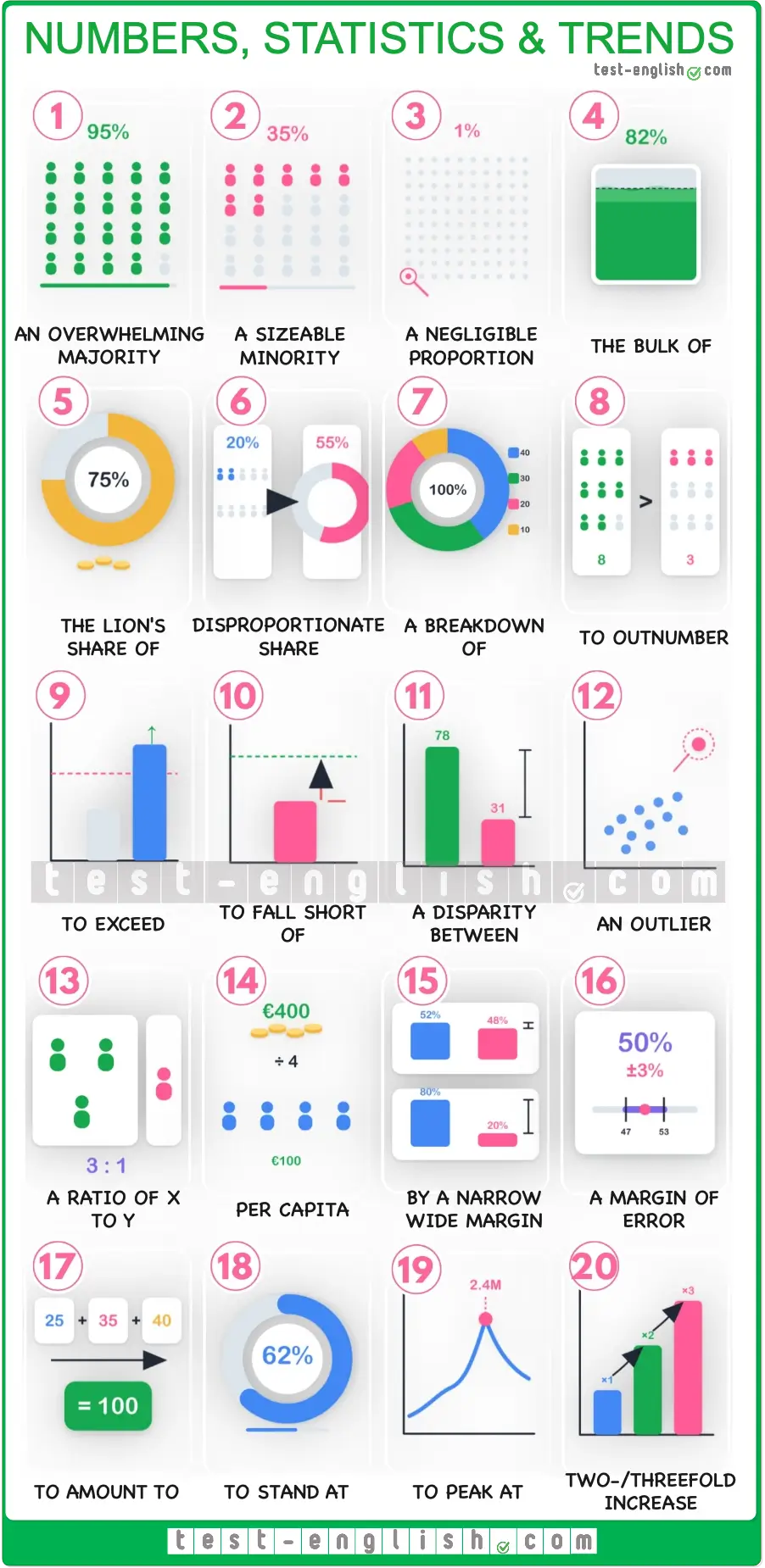
In this Advanced Vocabulary lesson, you will learn advanced vocabulary used to describe numbers, proportions, statistics, and trends. Check the chart below and read the definitions and example sentences to understand the terms and learn how to use them naturally in formal, academic, and everyday contexts.
Proportions and distribution
1 An overwhelming majority is a majority so large that only a relatively small proportion of the total remains.
- The proposal received the support of an overwhelming majority of respondents.
2 A sizeable minority is a minority that is large enough to be important or noticeable.
- A sizeable minority of employees work from home full-time.
3 A negligible proportion is such a small part of the total that it has little importance or effect.
- Only a negligible proportion of the equipment was damaged.
4 The bulk of something is the largest part or amount of it.
- The bulk of the applications were submitted online.
5 The lion’s share of something is the largest part of it, sometimes more than seems fair or reasonable.
- A small number of companies received the lion’s share of the available funding.
6 A disproportionate share is an amount that is too large or too small in relation to the total or compared with other groups.
- The wealthiest households consume a disproportionate share of the available resources.
7 A breakdown of figures or information is a detailed division of the total into separate categories.
- The report provides a breakdown of expenditure by region and age group.
Comparisons and statistical differences
8 To outnumber another group means to be greater in number than that group.
- Female graduates now outnumber male graduates in several subject areas.
9 To exceed a number, amount, or limit means to be greater than it.
- The final cost of the project exceeded the original estimate by nearly 20%.
10 To fall short of a number, amount, or target means to fail to reach it.
- The response rate fell short of the researchers’ target.
11 A disparity between two groups or figures is a large difference between them, especially one that seems unfair or unexpected.
- The figures reveal a marked disparity between average incomes in urban and rural areas.
12 An outlier is a value or result that is very different from the others in a set of data.
- The unusually high figure for May was treated as an outlier.
13 A ratio of X to Y expresses the numerical relationship between two quantities.
- The ratio of applicants to available places was twelve to one.
14 Per capita means for each person in a particular population.
- The report compares annual healthcare spending per capita across the ten regions.
15 If something happens by a narrow margin, the difference between the two sides is small. If it happens by a wide margin, the difference is large.
- The proposal was rejected by a narrow margin.
- The second candidate won by a wide margin.
16 A margin of error is the amount by which the result of a survey or calculation may differ from the true figure.
- The difference between the two results falls within the survey’s margin of error.
Totals and trends
17 To amount to a particular figure means to add up to or reach that total.
- The individual payments amount to more than €2 million in total.
18 If a figure stands at a particular level, it is at that level at a specific time.
- The current approval rate stands at 62%.
19 To peak at a particular figure means to reach the highest level or value at that point.
- Visitor numbers peaked at 2.4 million in August.
20 A twofold increase means that an amount becomes twice as large, while a threefold increase means that it becomes three times as large.
- The city recorded a threefold increase in the number of electric vehicles over five years.
FlashcardsAfter completing the exercises in this lesson on Numbers, Statistics and Trends, you can use the unit’s Vocabulary Flashcards to revise and help you memorize the terms.

-

Download lessons and tests as PDFs
Upgrade to PRO for printable PDFs and a more personalised learning experience.
- PDFs for every lesson and test
- An ad-free experience
- Progress tracking
- Skill badges
- Learner leaderboards

Watch the one-minute PRO overview
Exercises
Explanation
Downloads