-
Government and politics – C1 English Vocabulary
Exercise 3
Complete the text using words from the box. You can use each option ONLY ONCE.
administration – ballot box – come into force – legislation – mandate – pass a law – polls – regulation – took office – turnout
-
Government and politics – C1 English Vocabulary
In this Advanced Vocabulary lesson, you will learn advanced vocabulary related to Government and Politics. Read the definitions and example sentences to learn how these terms are used naturally in formal and academic contexts.
Political systems and power structures
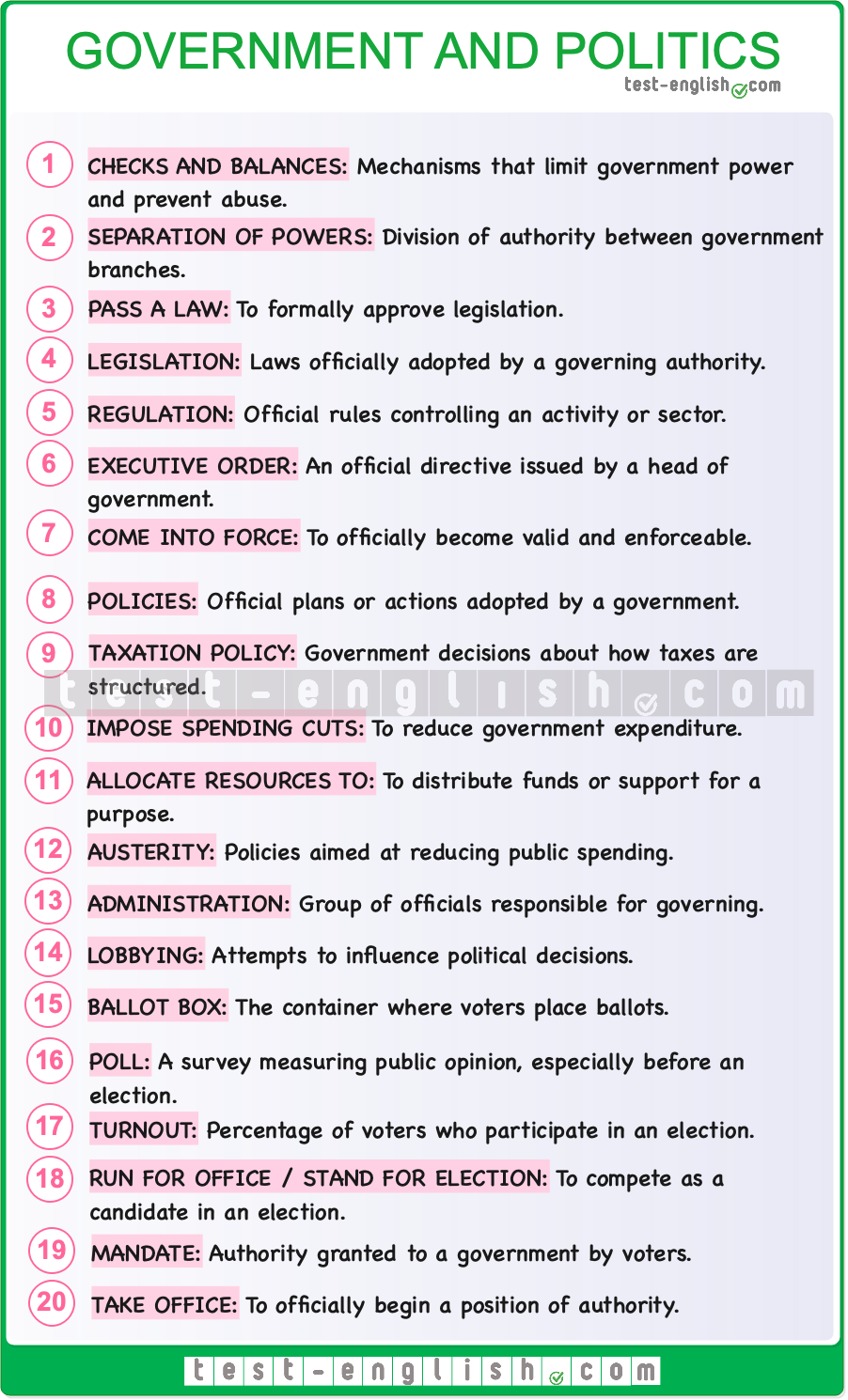
1 Checks and balances are mechanisms that limit the power of each branch of government and prevent any one institution from becoming too powerful.
- Checks and balances are essential for preventing the concentration of power in a single political authority.
2 The separation of powers refers to the division of authority between the executive, legislative, and judicial branches of government.
- The separation of powers is designed to protect individual rights.
Law-making and legal authority
3 To pass a law means to formally approve legislation through a legislative body.
- Parliament voted to pass a law regulating digital platforms.
4 Legislation refers to laws that are formally adopted by a governing authority.
- Controversial legislation was introduced to regulate artificial intelligence and data privacy.
5 Regulation consists of rules created by authorities to control or govern an activity or sector.
- Financial regulation was tightened after the crisis.
6 An executive order is a directive issued by a head of government that has the force of law.
- The president signed an executive order restricting exports.
7 If a law comes into force, it officially becomes valid and enforceable.
- The new policy will come into force in July.
Government action and economic policy
8 Policies are official plans or courses of action adopted by a government.
- The government’s immigration policies have sparked intense public debate.
9 Taxation policy refers to government decisions about how taxes are structured and applied.
- Changes to taxation policy affected middle-income households.
10 To impose spending cuts means to reduce government expenditure.
- The administration decided to impose spending cuts despite widespread protests.
11 To allocate resources to something means to distribute funds or support for a specific purpose.
- More resources were allocated to public transport.
12 Austerity refers to policies aimed at reducing public spending, especially during economic difficulty.
- Years of austerity reduced public debt but weakened essential public services.
Political actors and influence
13 The administration refers to the group of officials responsible for governing a country.
- The current administration promised institutional reform.
14 Lobbying is the practice of attempting to influence political decisions.
- Corporate lobbying intensified during negotiations over environmental legislation.
Elections, voting, and legitimacy
15 A ballot box is the container into which voters place their completed ballots.
- Voters queued patiently to cast their ballots at the ballot box.
16 A poll is an organised process in which people vote or express their opinions, especially in an election.
- Recent opinion polls suggest growing dissatisfaction with the current administration.
17 Turnout refers to the proportion of eligible voters who participate in an election.
- High voter turnout was interpreted as a sign of renewed political engagement.
18 To run for office (mainly US English) or stand for election (mainly UK English) means to compete as a candidate in an election.
- Several independent candidates chose to run for office.
- She announced her intention to stand for election in May.
19 A mandate is the authority granted to a government or leader by voters, usually for a fixed period of time.
- After securing a parliamentary majority, the government claimed a clear mandate to implement structural reforms.
20 To take office means to officially begin a position of authority.
- The new prime minister will take office next week.
FlashcardsAfter completing the exercises in this lesson on Government and Politics, you can use the unit’s Vocabulary Flashcards to revise and help you memorize the terms.

-

Download lessons and tests as PDFs
Upgrade to PRO for printable PDFs and a more personalised learning experience.
- PDFs for every lesson and test
- An ad-free experience
- Progress tracking
- Skill badges
- Learner leaderboards

Watch the one-minute PRO overview
Exercises
Explanation
Downloads