-
Eating and drinking
In this Advanced Vocabulary lesson on Eating and Drinking, you will learn advanced verbs, phrasal verbs, and common collocations used to describe eating habits, attitudes to food, and social meals. Check the explanation to familiarize yourself with the expressions before doing the exercises.
Exercise 1
Choose the correct option for each gap.
-
Eating and drinking
In this Advanced Vocabulary lesson on Eating and Drinking, you will learn advanced verbs, phrasal verbs, and common collocations used to describe eating habits, attitudes to food, and social meals. The pictures, definitions, and examples below will help you understand and remember the terms and use them naturally in context.
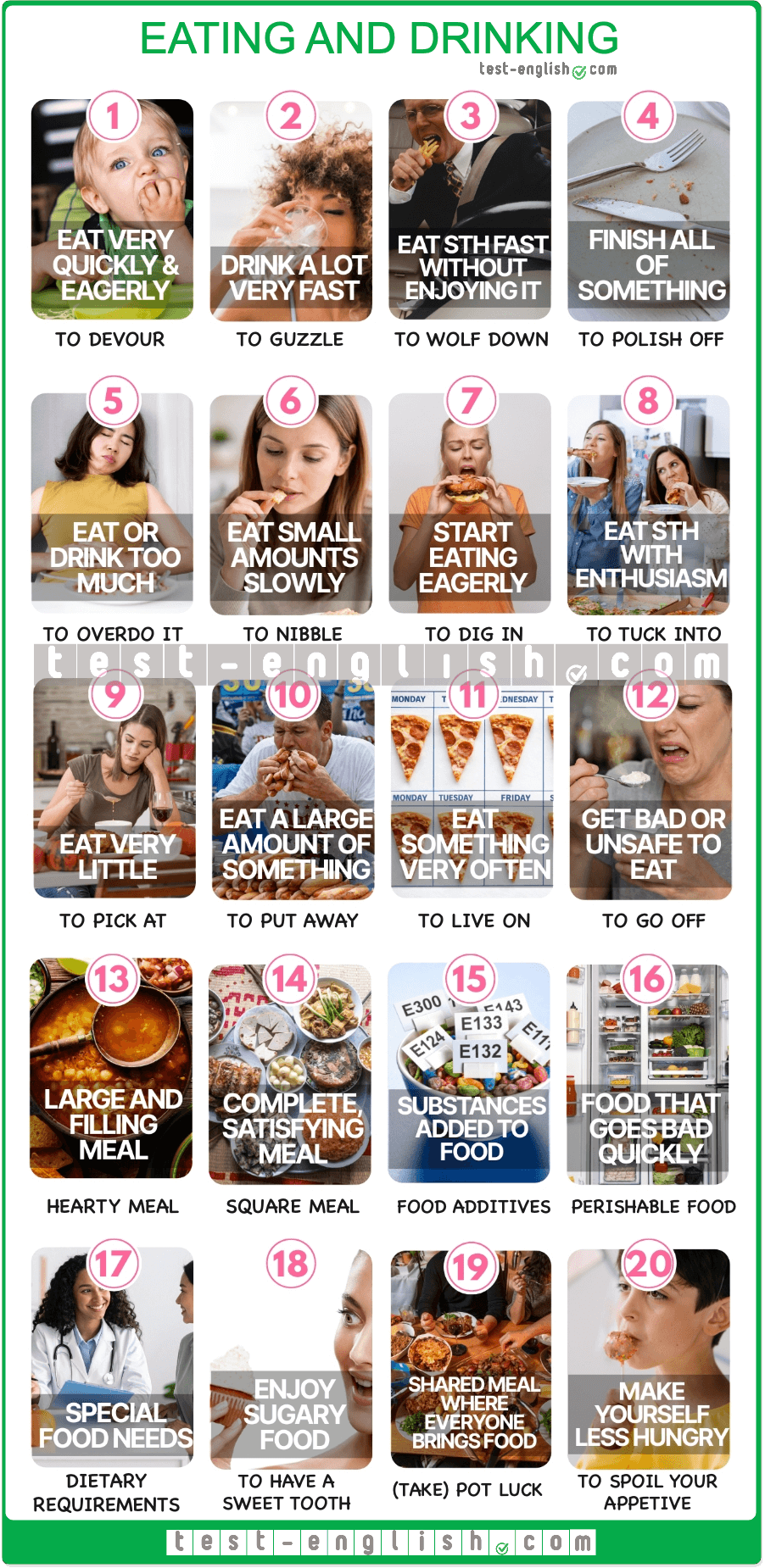
Verbs and phrasal verbs
1 If you devour food, you eat it very quickly and eagerly.
- After the race, he devoured a huge plate of pasta in minutes.
2 To guzzle something means to eat or drink it in large amounts, often too quickly.
- She guzzled two glasses of water as soon as she sat down.
3 If you wolf down food, you eat it very fast, often without enjoying it.
- He wolfed down his lunch and rushed back to work.
4 To polish off food means to finish it completely.
- She polished off the last slice of cake without hesitation.
5 If you overdo it, you eat or drink more than is sensible.
- I enjoyed the dessert, but I think I overdid it a bit.
6 To nibble means to eat small amounts of food slowly.
- She nibbled at her food like a little squirrel.
7 When you dig in, you start eating with enthusiasm.
- Everything was ready, so we were told to dig in.
8 To tuck into food means to eat with enthusiasm.
- They tucked into a generous Sunday lunch.
9 If you pick at food, you eat very little of it.
- She just picked at her food and left most of it untouched.
10 To put away food means to eat a large amount of it.
- He can put away an entire pizza on his own.
11 If you live on a particular food, you eat it very often.
- During exams, he practically lived on instant noodles.
12 When food goes off, it is no longer safe or pleasant to eat.
- This milk smells strange; I think it’s gone off.
Collocations and fixed expressions
13 A hearty meal or hearty breakfast is large and filling.
- After a long walk, we sat down to a hearty meal.
14 A square meal is a complete and satisfying meal.
- He hadn’t had a square meal all day.
15 Food additives are substances added to food to preserve it or improve flavour or appearance.
- Some people try to avoid products containing artificial food additives.
16 Perishable food is food that goes bad quickly.
- Make sure perishable food is kept in the fridge.
17 Dietary requirements are special food needs or restrictions.
- Please let us know if you have any dietary requirements.
18 If you have a sweet tooth, you enjoy sugary food.
- I’m trying to eat less sugar, but I really have a sweet tooth.
19 To take pot luck means to accept whatever food is available, without choosing (British English). In American English, potluck is a noun referring to a shared meal where each guest brings a dish.
- There’s no menu tonight, so we’ll just take pot luck.
- We’re having a potluck dinner, so everyone is bringing something to share.
20 If something spoils your appetite, it reduces your desire to eat.
- Too many snacks beforehand can spoil your appetite.
FlashcardsAfter completing the exercises in this lesson on Eating and Drinking, you can use the unit’s Vocabulary Flashcards to revise and help you memorize the terms.

-

Download lessons and tests as PDFs
Upgrade to PRO for printable PDFs and a more personalised learning experience.
- PDFs for every lesson and test
- An ad-free experience
- Progress tracking
- Skill badges
- Learner leaderboards

Watch the one-minute PRO overview
Exercises
Explanation
Downloads


