-
Cause and effect – C1 English Vocabulary
In this Advanced Vocabulary lesson, you will learn advanced verbs, expressions, and common collocations used to describe causes, consequences, and reactions. The chart, definitions, and example sentences below will help you understand and remember the terms and use them naturally in context. Read the definitions and example sentences to learn how these terms are used naturally.
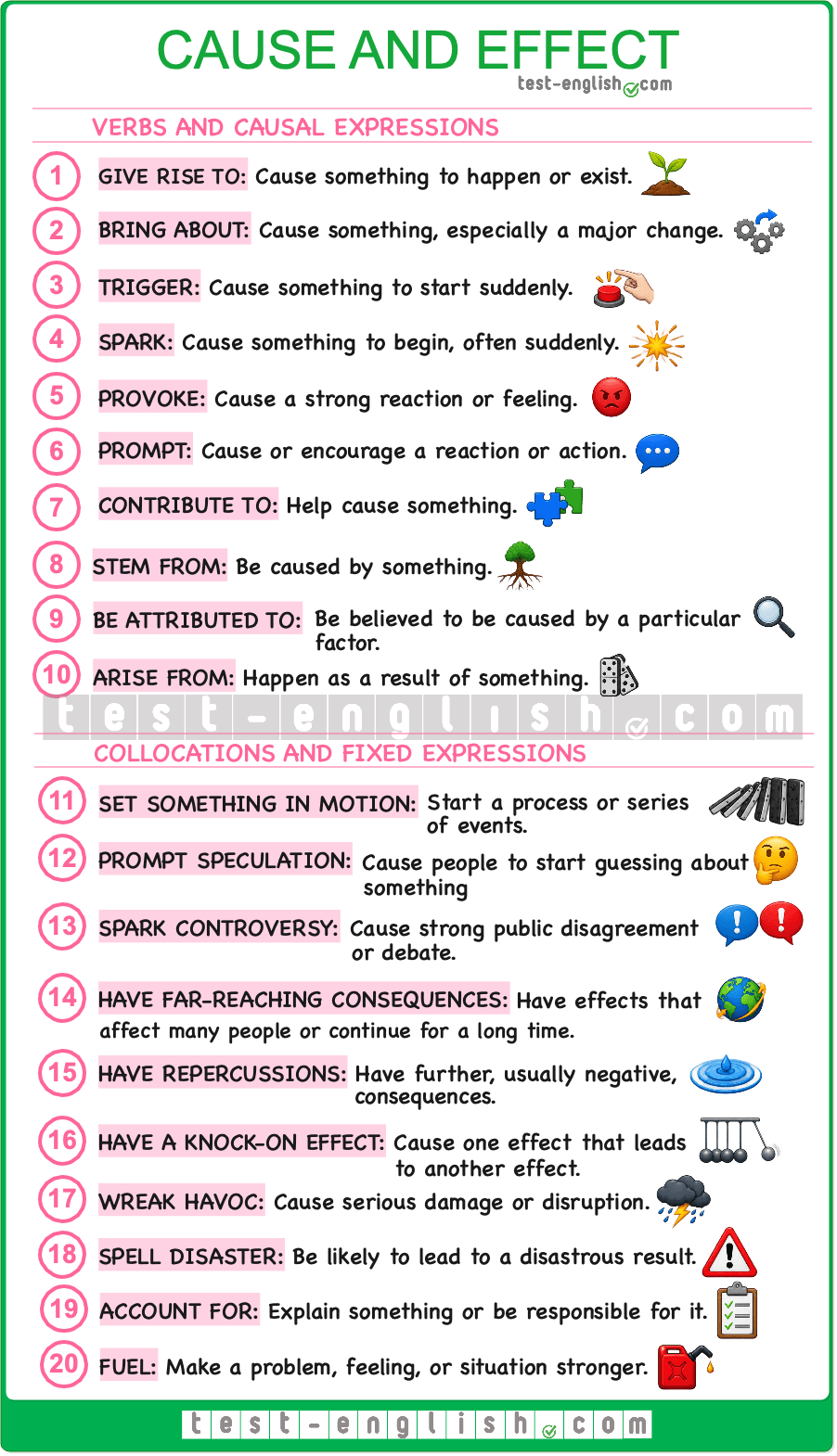
Verbs and causal expressions
1 To give rise to something means to cause it to happen or exist, especially a problem, concern, reaction, or situation.
- The rapid growth of tourism has given rise to concerns about overcrowding.
2 To bring about something means to cause it, especially a change, improvement, or development.
- The new technology could bring about major changes in the way we work.
3 To trigger something means to cause it to start suddenly.
- The announcement triggered a sharp fall in share prices.
4 To spark something means to cause it to begin, often suddenly, especially a debate or discussion.
- The decision sparked a heated debate about privacy.
5 To provoke something means to cause a strong reaction or feeling.
- His comments provoked an angry response from local residents.
6 To prompt something means to cause or encourage a reaction or action. It is often followed by a person or organisation and an infinitive structure: ‘prompt someone to do something’.
- The accident prompted the authorities to review safety procedures.
7 To contribute to something means to help cause it.
- A lack of affordable housing has contributed to rising homelessness.
8 If something stems from something else, it is caused by it.
- Many of the problems stem from a lack of long-term planning.
9 If something is attributed to a particular cause, that cause is believed to be responsible for it.
- The increase in sales has been attributed to the company’s new advertising campaign.
10 If something arises from something else, it happens as a result of it.
- Most disputes arise from misunderstandings rather than genuine disagreements.
Collocations and fixed expressions
11 To set something in motion means to start a process or series of events.
- The discovery set in motion a series of investigations.
12 To prompt speculation means to cause people to start guessing about something.
- Her sudden resignation prompted speculation about problems within the company.
13 To spark controversy means to cause strong public disagreement or debate.
- The proposed law has sparked controversy among doctors and politicians.
14 To have far-reaching consequences means to have important effects that affect many people or continue for a long time.
- The decision could have far-reaching consequences for the entire industry.
15 To have repercussions means to have further, usually negative, consequences.
- Cutting funding for education could have serious repercussions for future generations.
16 To have a knock-on effect means to cause an indirect effect that leads to further effects.
- Higher fuel prices can have a knock-on effect on the cost of food and other goods.
17 To wreak havoc means to cause serious damage or disruption.
- The storm wreaked havoc across the region, damaging homes and roads.
18 If something spells disaster, it is likely to lead to a disastrous result.
- A further rise in interest rates could spell disaster for heavily indebted businesses.
19 To account for something means to explain why something happened or represent a particular amount of something.
- Poor maintenance accounted for many of the equipment failures.
20 To fuel something means to make a problem, feeling, or situation stronger. It is often used with negative things such as anger, fears, speculation, or conflict.
- Rising prices have fuelled public anger over the cost of living.
FlashcardsAfter completing the exercises in this lesson on Cause and Effect, you can use the unit’s Vocabulary Flashcards to revise and help you memorize the terms.

-

Download lessons and tests as PDFs
Upgrade to PRO for printable PDFs and a more personalised learning experience.
- PDFs for every lesson and test
- An ad-free experience
- Progress tracking
- Skill badges
- Learner leaderboards

Watch the one-minute PRO overview
Exercises
Explanation
Downloads