-
In this Advanced Vocabulary lesson, you will learn advanced language for presenting, supporting and challenging arguments in formal discussions and writing. Check the chart below and read the definitions and sentence examples to understand their meanings and learn how to use them naturally in context.
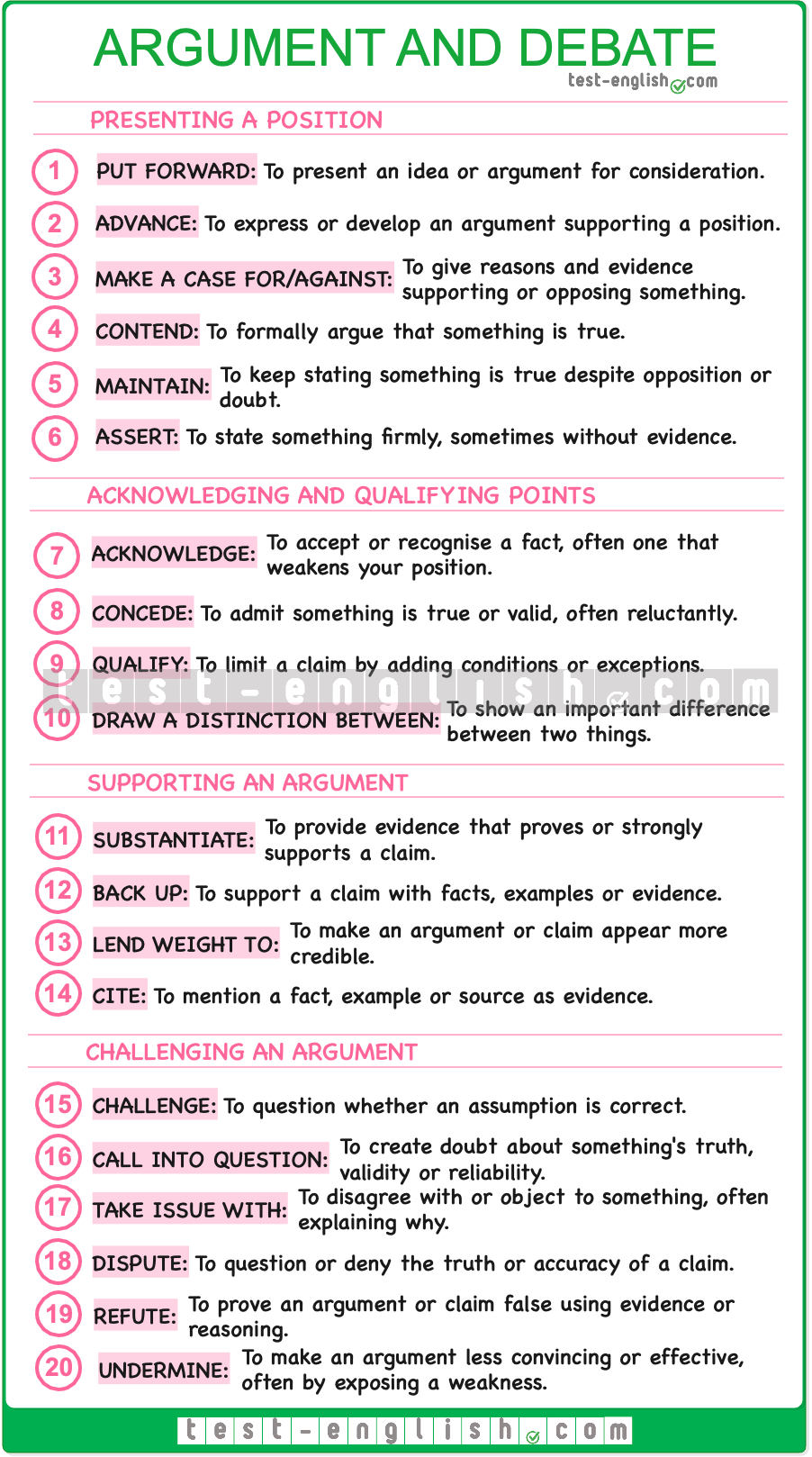
Presenting a position
1 If you put forward an argument, proposal, idea, or explanation, you present it for other people to consider or discuss.
- In light of the latest figures, the committee put forward an argument for extending the programme.
2 If you advance an argument, theory, or interpretation, you express or develop it in support of a particular position, especially in formal discussion or writing.
- The article advances the argument that greater flexibility can improve employee productivity.
3 If you make a case for/against something, you give reasons and evidence intended to persuade people to support or oppose it. A case is often described as strong, compelling, or convincing.
- The researchers made a compelling case for conducting a larger follow-up study.
4 If you contend that something is true, you formally argue or state that it is true, especially when other people may disagree.
- The authors contend that the apparent decline reflects a change in reporting methods.
5 If you maintain that something is true, you continue to state that it is true despite opposition or doubt.
- Notwithstanding the criticism, officials maintain that the new procedure is both fair and reliable.
6 If you assert that something is true, you state it firmly and confidently, sometimes without providing evidence.
- The manufacturer asserted that the product had undergone extensive safety testing.
Acknowledging and qualifying points
7 If you acknowledge a fact, problem, or weakness, or acknowledge that something is true, you accept or recognise it, often when it weakens your position.
- Even supporters of the proposal acknowledge that it would be expensive to implement.
8 If you concede a point or argument, or concede that something is true, you admit that it is valid, often reluctantly or after previously arguing against it.
- After reviewing the evidence, the spokesperson conceded that serious mistakes had been made.
9 If you qualify a claim, statement, or conclusion, you add limits, conditions, or exceptions to show that it does not apply in every case.
- The researchers qualified their original claim by stating that the effects might vary between regions.
10 If you draw a distinction between two things, you show that there is an important difference between them.
- The report draws a distinction between temporary disruption and permanent economic damage.
Supporting an argument
11 If you substantiate a claim, allegation, or accusation, you provide evidence that proves or strongly supports it.
- The company failed to substantiate its claim that the treatment produced lasting benefits.
12 If you back up a claim, argument, or assertion, you provide facts, examples, or other evidence that supports it.
- She backed up her claim with data collected over a ten-year period.
13 If something lends weight to an argument, claim, theory, or view, it makes it appear more convincing or credible.
- The latest findings lend weight to the argument for tighter safety regulations.
14 If you cite a fact, example, source, or study as evidence, you mention it to support an argument.
- Campaigners cited the repeated delays as evidence that the project had been poorly managed.
Challenging an argument
15 If you challenge an assumption, claim, conclusion, or interpretation, you question whether it is correct or valid.
- The study challenges the assumption that longer working hours necessarily lead to greater productivity.
16 If you call into question a claim, decision, or finding, you create doubt about its truth, validity, or reliability.
- The witness’s account was called into question by the conflicting testimony.
17 If you take issue with a statement, opinion, interpretation, or decision, you disagree with it and often explain why you believe it is wrong.
- Several reviewers took issue with the author’s interpretation of the results.
18 If you dispute a claim, allegation, account, or finding, you question or deny its truth or accuracy.
- The union disputes the claim that the changes will improve working conditions.
19 If you refute an argument, claim, assertion, or theory, you prove that it is false or incorrect by using evidence or logical reasoning.
- The newly released figures refute the argument that demand has fallen substantially.
20 If something undermines an argument, case, position, or theory, it makes it less convincing or effective, often by exposing a weakness in it.
- Failing to address these counterexamples undermines the report’s central argument.
FlashcardsAfter completing the exercises in this lesson on Argument and Debate, you can use the unit’s Vocabulary Flashcards to revise and help you memorize the terms.

-

Download lessons and tests as PDFs
Upgrade to PRO for printable PDFs and a more personalised learning experience.
- PDFs for every lesson and test
- An ad-free experience
- Progress tracking
- Skill badges
- Learner leaderboards

Watch the one-minute PRO overview
Exercises
Explanation
Downloads