-
Adverb-adjective collocations
In this Advanced Vocabulary lesson, you will learn common adverb + adjective/past participle collocations. These combinations are very frequent in essays, reviews and reports, but learners often use unnatural alternatives such as very + adjective. Check the table below and read the sentence examples to learn how to use them naturally in context.
Adverb + adjective collocations
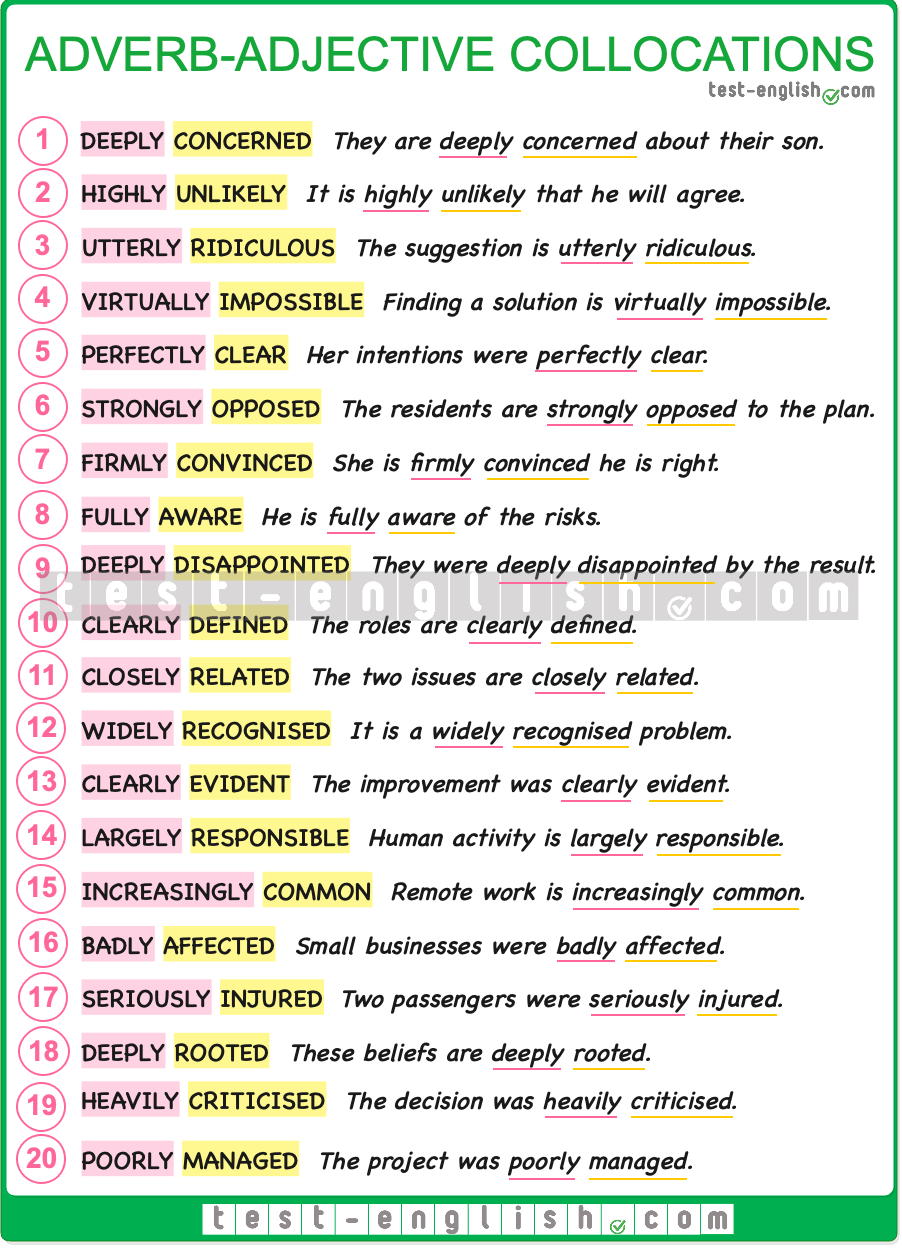
1 deeply concerned- The local residents are deeply concerned about the environmental impact of the project.
2 highly unlikely
- It is highly unlikely that the proposal will be approved without major changes.
3 utterly ridiculous
- The idea that technology can solve every problem is utterly ridiculous.
4 virtually impossible
- Under the current conditions, meeting the deadline is virtually impossible.
5 perfectly clear
- It was perfectly clear from his response that he disagreed.
6 strongly opposed
- Several experts are strongly opposed to the proposed reforms.
7 firmly convinced
- She is firmly convinced that education is the key to long-term change.
8 fully aware
- The company is fully aware of the risks involved.
9 deeply disappointed
- Many supporters were deeply disappointed by the final decision.
10 clearly defined
- The roles and responsibilities must be clearly defined from the start.
11 closely related
- Language and culture are closely related and cannot be studied in isolation.
12 widely recognised
- Climate change is a widely recognised global challenge.
13 clearly evident
- The improvement in her confidence was clearly evident.
14 largely responsible
- Human activity is largely responsible for the decline in biodiversity.
15 increasingly common
- Remote working has become increasingly common in recent years.
16 badly affected
- Small businesses were badly affected by the economic downturn.
17 seriously injured
- Several passengers were seriously injured in the accident.
18 deeply rooted
- These attitudes are deeply rooted in the country’s history.
19 heavily criticised
- The policy was heavily criticised by both the media and the public.
20 poorly managed
- The project failed because it was poorly managed from the outset.
FlashcardsAfter completing the exercises in this lesson on Adverb-adjective Collocations, you can use the unit’s Vocabulary Flashcards to revise and help you memorize the terms.

-

Download lessons and tests as PDFs
Upgrade to PRO for printable PDFs and a more personalised learning experience.
- PDFs for every lesson and test
- An ad-free experience
- Progress tracking
- Skill badges
- Learner leaderboards

Watch the one-minute PRO overview
Exercises
Explanation
Downloads


