-
Advantages, disadvantages and trade-offs – C1 English Vocabulary
In this Advanced Vocabulary lesson, you will learn advanced words and expressions used to discuss advantages, disadvantages, compromises, and the factors involved in making decisions. Read the definitions and example sentences to understand the differences between the terms and learn how to use them naturally in formal, academic, and everyday contexts.
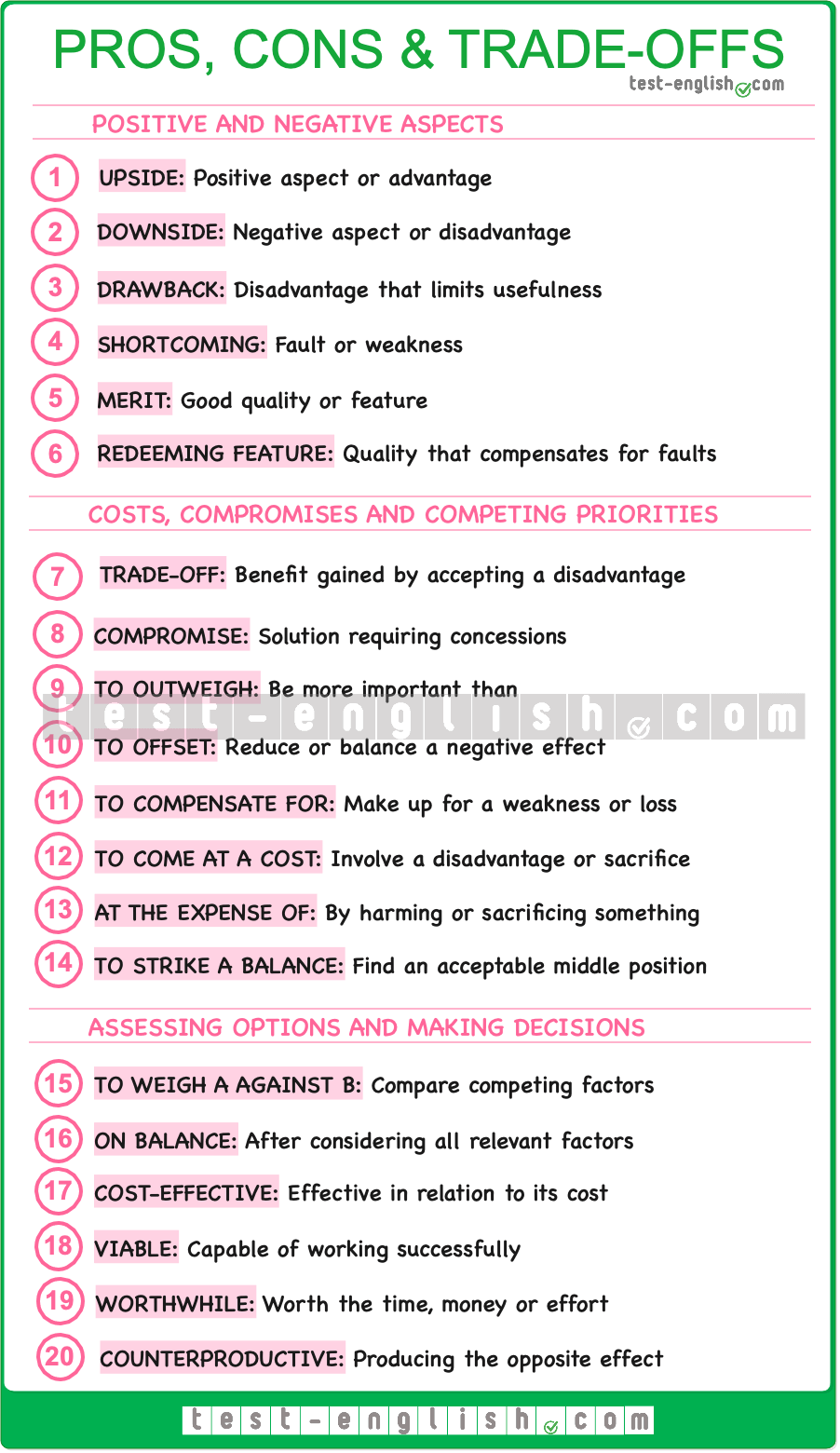
Positive and negative aspects
1 The upside of something is its positive aspect or advantage, especially when it is contrasted with a disadvantage.
- The main upside of the four-day week is that staff have more time to recover.
2 The downside of something is its negative aspect or disadvantage.
- The downside of remote recruitment is that candidates may find it harder to assess workplace culture.
3 A drawback is a disadvantage that makes something less useful, effective, or attractive.
- A major drawback of the proposal is its reliance on short-term funding.
4 A shortcoming is a fault or weakness in a person, system, plan, or product. The plural form is particularly common.
- The review identified several shortcomings in the way complaints were handled.
5 A merit is a good quality or feature that makes an idea, proposal, or course of action worthy of consideration.
- The idea has considerable merit, although its implementation would be expensive.
6 A redeeming feature is a positive quality that partly compensates for the faults of something that is otherwise disappointing.
- The hotel’s only redeeming feature was its convenient location.
Costs, compromises and competing priorities
7 A trade-off is a situation in which gaining one benefit requires accepting a disadvantage or giving up another benefit.
- The cheaper model costs less, but the trade-off is that its battery life is considerably shorter.
- There is an unavoidable trade-off between stronger data protection and ease of access.
8 A compromise is an agreement or solution in which different sides accept less than they originally wanted, or in which competing qualities are balanced.
- The final design represents a compromise between durability and weight.
9 If one consideration outweighs another, it is more important or has a greater effect.
- For most residents, the long-term benefits outweigh the temporary disruption.
10 To offset a cost, disadvantage, or negative effect means to reduce or balance it with something positive.
- Lower maintenance costs should offset the higher initial price.
11 To compensate for a disadvantage, weakness, or loss means to provide something positive that makes it less serious or noticeable.
- The generous annual leave partly compensates for the relatively modest salary.
12 If something comes at a cost, it produces a benefit but also causes a disadvantage, loss, or difficulty.
- Greater accuracy often comes at the cost of speed.
13 If something is achieved at the expense of something else, it is achieved by reducing, harming, or sacrificing that other thing.
- The company increased output at the expense of product quality.
14 To strike a balance between two competing considerations means to find a satisfactory middle position that takes both into account.
- The regulations attempt to strike a balance between public safety and individual freedom.
Assessing options and making decisions
15 To weigh something against something means to compare two competing factors carefully before reaching a decision.
- The council must weigh the economic benefits against the environmental risks.
16 On balance is used to introduce an overall judgement reached after considering all the relevant advantages and disadvantages.
- On balance, extending the trial is preferable to abandoning it.
17 Something is cost-effective if it produces a good result without costing more than is reasonable or necessary.
- Replacing every device would not be cost-effective, given how few are faulty.
18 An idea, plan, or business is viable if it is capable of working successfully in practice.
- Without additional investment, the service is unlikely to remain financially viable.
19 Something is worthwhile if its benefits justify the time, money, or effort required.
- The upgrade is costly, but the improvement in reliability makes it worthwhile.
20 Something is counterproductive if it has the opposite effect to the one intended.
- Publishing incomplete figures could be counterproductive and further weaken public trust.
FlashcardsAfter completing the exercises in this lesson on Advantages, Disadvantages and Trade-offs, you can use the unit’s Vocabulary Flashcards to revise and help you memorize the terms.

-

Download lessons and tests as PDFs
Upgrade to PRO for printable PDFs and a more personalised learning experience.
- PDFs for every lesson and test
- An ad-free experience
- Progress tracking
- Skill badges
- Learner leaderboards

Watch the one-minute PRO overview
Exercises
Explanation
Downloads