-
Everyday problems and solutions
In this Pre-intermediate Vocabulary Lesson about about Everyday Problems and Solutions, you will learn useful phrases to talk about common problems in daily life and what you can do to solve them. Review the explanation to get comfortable with the vocabulary before moving on to the exercises.
Exercise 1
Choose the correct option for each gap.
-
Everyday problems and solutions
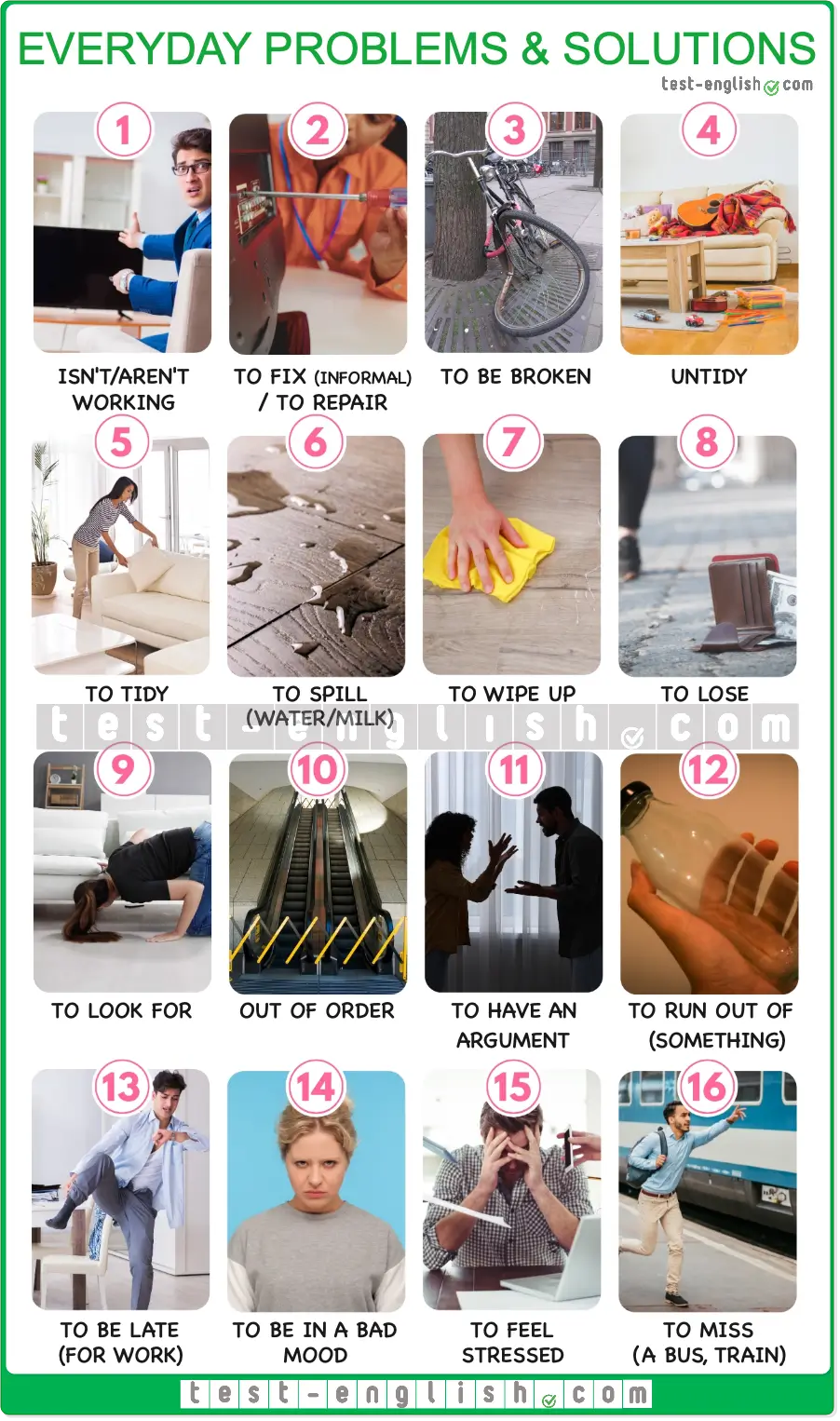
In this Pre-intermediate Vocabulary Lesson about Everyday Problems and Solutions, you will learn useful phrases to talk about common problems in daily life and what you can do to solve them. The pictures, descriptions, and examples below will help you understand and remember the terms.
Problems and their solutions
If a machine (a television, a computer, etc.) 1 isn’t working, you need to 2 repair it (or fix it).
- My TV isn’t working; do you think you can repair it?
If something (a bicycle, a window, etc.) is 3 broken, you need to fix it (or repair it).
- My bicycle is broken, so I’m going to try and fix it.
🔍 Repair and fix have the same meaning, but fix is more informal and more common when people speak.If a room is 4 untidy, things are not in the correct place, or the room is messy, so you need to 5 tidy it (make it neat and clean).
- The living room is untidy. Could you please tidy it before the guests arrive?
If you 6 spill something (water, coffee, etc.), you need to 7 wipe it up (clean it with a towel or cloth).
- If you spill water on the floor, please wipe it up with a towel.
If you 8 lose something (keys, a book, etc.), you need to 9 look for it.
- I‘ve lost my wallet. Can you help me look for it?
Other problems
10 If a machine (an elevator, photocopier, etc.) is out of order, it isn’t working, and you can’t use it.
- The printer was out of order, so I couldn’t print my essay.
11 If you have an argument with someone, you don’t agree and may speak angrily to each other.
- I knew they were having an argument because I could hear shouting in the next room.
12 If you run out of something (bread, milk, etc.), you don’t have any left, so you need to get some more.
- We‘re running out of milk, so we need to go to the shop.
13 If you‘re late for work, you arrive after the correct time.
- If you don’t leave now, you‘ll be late for work.
14 If you‘re in a bad mood, you may feel angry or unhappy, perhaps because something bad has happened.
- I was in a bad mood because the neighbours were making too much noise.
15 If you feel stressed, you feel worried or nervous because you have to do too many things.
- I‘m feeling stressed because I’ve got too many exams to study for.
16 If you miss a train or a bus, you arrive too late at the station or stop, and the train or bus has already gone.
- She missed the bus and had to walk to school.
FlashcardsAfter completing the exercises in this lesson on Everyday Problems and Solutions, you can use the unit’s Vocabulary Flashcards to revise and help you memorize the terms.

-

Download lessons and tests as PDFs
Upgrade to PRO for printable PDFs and a more personalised learning experience.
- PDFs for every lesson and test
- An ad-free experience
- Progress tracking
- Skill badges
- Learner leaderboards

Watch the one-minute PRO overview
Exercises
Explanation
Downloads


