-
The perfect aspect describes an action or state that happened before a particular point in time. It links an earlier action or state to a later reference point.
The perfect tenses
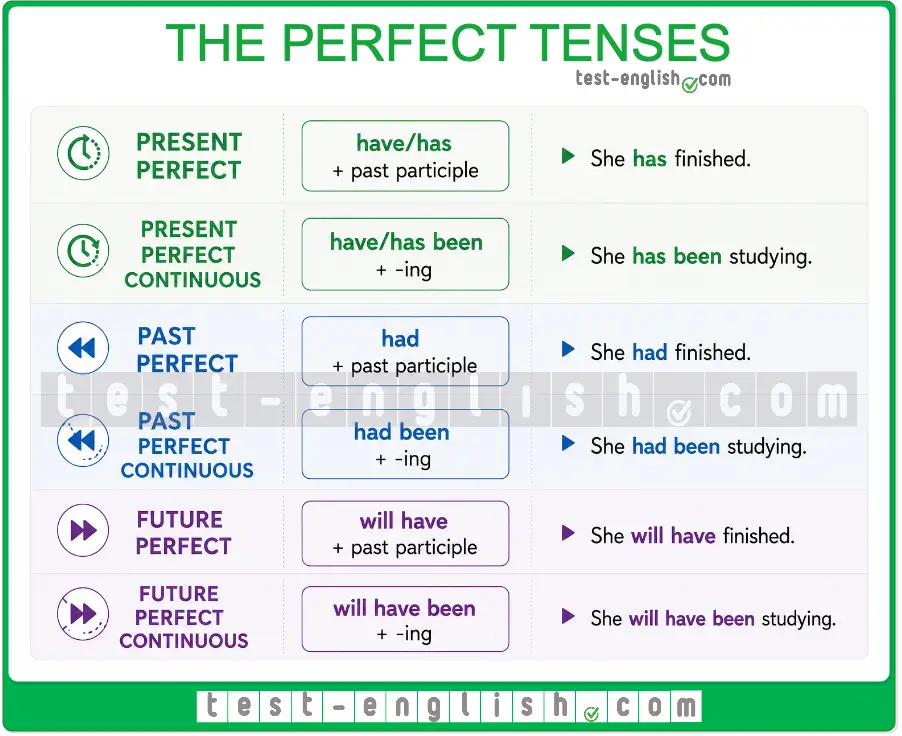
English has six perfect tenses. They are formed with the auxiliary verb have followed by a past participle. Depending on the tense, the reference point may be in the present, the past, or the future.
Download full-size image from Pinterest
Present perfect
The present perfect describes an action or state that happened before the present moment. It looks back from now, often emphasising a present result, an unfinished situation, or a past experience.
Common uses
1️⃣ Present results: I‘ve lost my keys.2️⃣ Life experiences: She‘s been to Japan.
3️⃣ Unfinished situations: We‘ve lived here for ten years.
4️⃣ Repeated actions up to now: I‘ve seen that film three times.
5️⃣ Actions in unfinished time periods: I‘ve had two meetings today.
Common time expressions
‣ Recent events: just, already, yet, recently, lately
‣ Life experiences: ever, never, before
‣ Duration: for, since, how long
‣ Unfinished time periods: today, this week, this month, this year, so far, up to now, over the last…Common patterns
🔹 It / This / That is the first (second, only, etc.) time…
- This is the first time I‘ve visited London.
🔹 Superlatives + ever
- It’s the best film I‘ve ever seen.
🔹 Since + past simple
- I‘ve lived here since I finished university.
🔹 Present perfect in future time clauses
- I’ll call you when I‘ve finished.
🔹 News reporting
- The police have arrested two suspects. They were arrested early this morning.
🔹 Two present perfect clauses
- Since I‘ve known him, he‘s always worn a suit.
Past perfect
The past perfect describes an action or state that happened before a point in the past. It looks back from a past reference point, often making the order of past events clear.
Common uses
1️⃣ Completed actions before another past action: She‘d left before I arrived.2️⃣ Unfinished situations before a past point: We‘d lived there for ten years before we moved.
3️⃣ Past experiences before a past point: I‘d never seen snow before I moved to Canada.
4️⃣ The cause of a past situation: She was upset because she‘d failed the exam.
Common time expressions
‣ Earlier actions: already, just, before, by then, until then, previously‣ Past experiences: ever, never, before
‣ Duration: for, since
‣ Sequence of events: before, after, by the time, when, once
Common patterns
🔹 Past perfect is often optional if the sequence of events is clear
- After she (had) finished, she went home.
🔹 By the time…
- By the time we arrived, they‘d already left.
🔹 Reported speech
- He said he‘d never seen anything like it before.
🔹 Third conditional
- If I‘d known, I would have told you.
🔹 Wish / If only + past perfect
- I wish I ‘d studied harder.
🔹 Unfulfilled plans and expectations
- I‘d hoped to see her, but she was away.
- She‘d expected the exam to be easier.
Future perfect
The future perfect describes an action or state that will happen before a point in the future. It looks back from a future reference point, often emphasising that something will be completed by that time.
Common uses
1️⃣ Completed actions before a future point: By Friday, I‘ll have finished the report.2️⃣ Duration up to a future point: Next month, we‘ll have lived here for ten years.
3️⃣ Achievements by a future time: By the age of 30, she‘ll have written three novels.
4️⃣ Assumptions and deductions: Don’t call now. They‘ll have gone to bed.
Common time expressions
‣ Future deadlines: by tomorrow, by Friday, by next week, by the end of the month‣ Future reference points: by then, by that time, by the time…
‣ Duration up to a future point: for, since
‣ Assumptions and deductions: probably, almost certainly, surely, no doubt
Common patterns
🔹 By + future time
- By next year, she‘ll have completed her degree.
🔹 By the time + present simple
- By the time you get home, I‘ll have made dinner.
🔹 Duration with for and since
- In June, they‘ll have been married for twenty years.
🔹 Assumptions and deductions
- She‘ll have heard the news by now.
Perfect simple vs Perfect continuous
Perfect simple forms usually focus on the result, completion or number of actions. Perfect continuous forms usually focus on the activity, duration or ongoing nature of an action.
Main differences
1️⃣ Result vs activity: I‘ve written three emails. / I‘ve been writing emails all morning.
2️⃣ Completed quantity vs duration: She‘s read fifty pages. / She‘s been reading for two hours.
3️⃣ Completed result vs ongoing or recent activity: They‘ve built a new school. / They‘ve been building a new school.
4️⃣ Single action vs repeated activity: I‘ve called him once. / I‘ve been calling him all morning.Across different perfect tenses
🔹 Present perfect
- I‘ve painted the room. = The room is finished.
- I‘ve been painting the room. = The activity is important; it may or may not be finished.
🔹 Past perfect
- She‘d cleaned the house before they arrived. = The house was clean.
- She‘d been cleaning the house all morning. = The activity explains why she was tired.
🔹 Future perfect
- By June, I‘ll have worked here for ten years.
- By June, I‘ll have been working here for ten years.
State verbs and action verbs
State verbs such as know, believe, understand, own, belong, like, love, hate and want are normally used in perfect simple forms, not perfect continuous forms.
With action verbs, both forms are often possible, but the perfect continuous is usually preferred when the emphasis is on duration or an ongoing activity.
- I‘ve known her for years.

- I‘ve been knowing her for years.

- I‘ve been working all day.
- I‘ve worked all day. (possible, but less common)
With verbs such as live, work, teach and study, the perfect simple is common when describing permanent or long-term situations, whereas the perfect continuous is more often used to emphasise an ongoing activity, often suggesting that the situation is more temporary.
- I’ve worked here for thirty years.
- I’ve been working here for six months.

-

Download lessons and tests as PDFs
Upgrade to PRO for printable PDFs and a more personalised learning experience.
- PDFs for every lesson and test
- An ad-free experience
- Progress tracking
- Skill badges
- Learner leaderboards

Watch the one-minute PRO overview
Exercises
Explanation
Downloads