-
Prepositions: Position and advanced patterns
Exercise 2
Complete the texts with the words and phrases in the box. There are two extra options.
a view to – addition to – apart from – as for – by means of – for fear of – in place of – in the absence of – in the event of – on top of – regard to – subject to
-
Prepositions: Position and advanced patterns
Prepositions can appear in different positions depending on the structure and level of formality. This lesson examines these differences and other advanced patterns.
The chart below summarises how prepositions are used in questions, relative clauses, passive and infinitive structures, and advanced prepositional phrases.
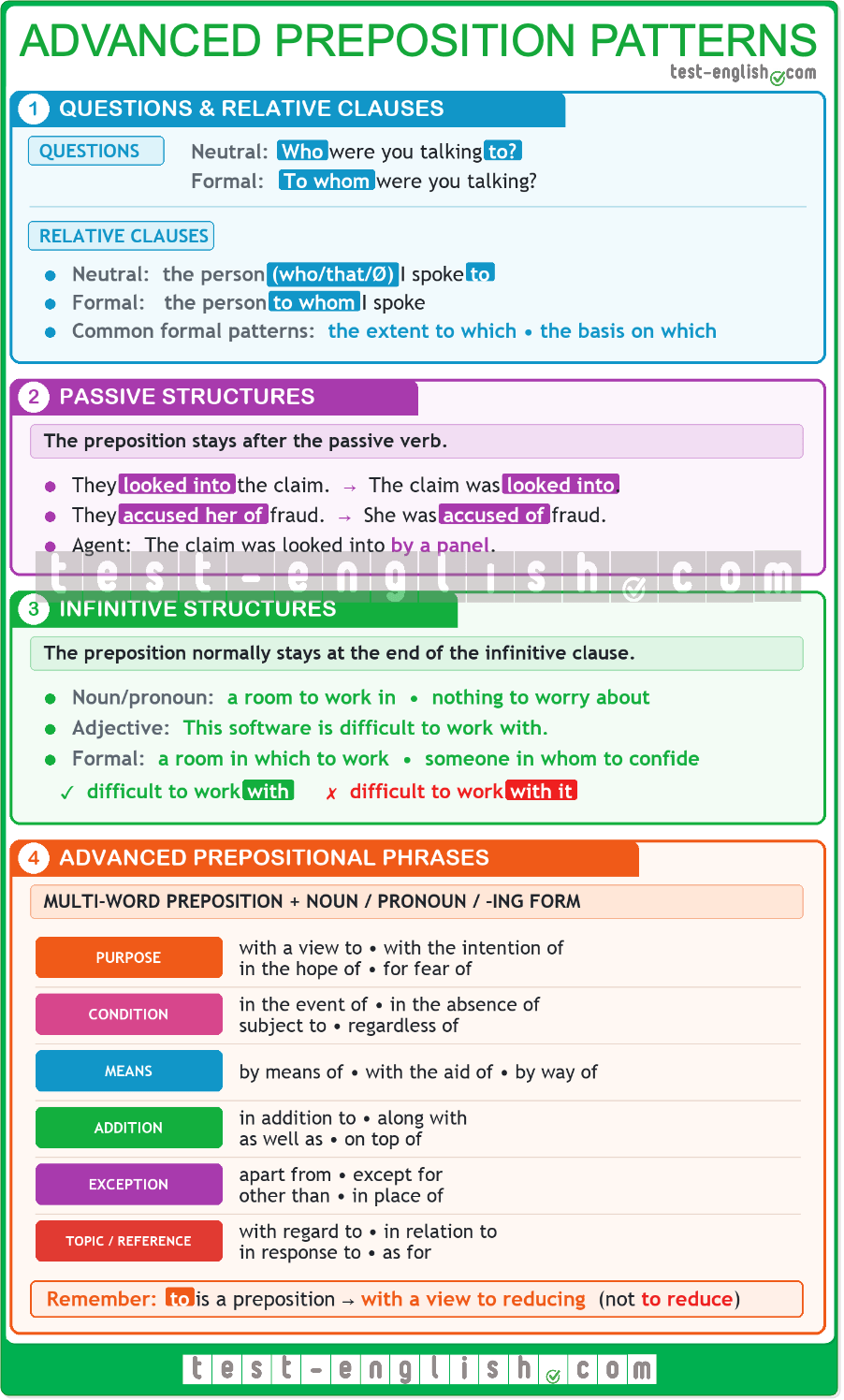
Download full-size image from Pinterest
Prepositions in questions and relative clauses
When a question word or relative pronoun is connected to a preposition, the preposition can often appear either at the end of the clause or before the question word or relative pronoun. Both positions can be grammatically correct, but they are generally used in different registers.
Prepositions in questions
In neutral and informal English, the preposition normally comes at the end of the question. This is known as preposition stranding. We normally use who, rather than whom, in this type of question.
🔹 Question word + auxiliary + subject + verb + preposition- Who were you talking to?
- What did the sudden decline stem from?
- Which problems did the new policy contribute to?
In more formal English, particularly in careful writing, the preposition can be placed before the question word. We use whom for people after a preposition, not who.
🔹 Preposition + whom/what/which + auxiliary + subject + verb- To whom were you talking?
- From what did the sudden decline stem?
- To which problems did the new policy contribute?
Ending a question with a preposition is not incorrect. In fact, the final position is usually more natural in conversation. Putting the preposition first creates a noticeably more formal style and may sound unnatural in everyday speech.
Prepositions in relative clauses
As explained in our B2 lesson on relative clauses, a preposition can also appear at the end of a relative clause. This is the usual position in neutral and informal English.
In defining relative clauses, when the preposition comes at the end, we can use who, whom or that for people, and which or that for things. Whom is the object form of who, but who is much more common in everyday English when the preposition is at the end. Because the relative pronoun is an object, it can also be omitted.
🔹 Noun + (relative pronoun) + subject + verb + preposition- The consultant (who/whom/that) the journalists spoke to refused to comment.
- The principles (which/that) the decision was based on were never made public.
- These are the conditions (which/that) both sides had agreed to.
In more formal relative clauses, the preposition can come before the relative pronoun. In this structure, we use whom for people and which for things. We cannot use who or that, and the relative pronoun cannot be omitted.
🔹 Noun + preposition + whom/which + subject + verb- The consultant to whom the journalists spoke refused to comment.
- The principles on which the decision was based were never made public.
- These are the conditions to which both sides had agreed.
We can also place a preposition before whose + noun in formal relative clauses.
- The researcher on whose work the theory is based has questioned the findings.
Common formal patterns with which
Certain combinations of preposition + which are particularly common in formal and academic English. These include the extent to which, the circumstances under which, the basis on which and the process by which.
- The study examined the extent to which sleep deprivation affects memory.
- They refused to reveal the basis on which the applications had been rejected.
- The report describes the circumstances under which the agreement was reached.
- The researchers explained the process by which the samples had been selected.
Prepositions in passive structures
When a verb followed by a preposition is used in the passive, the preposition stays after the passive verb.
Passive forms of verb + preposition
🔹 Active: subject + verb + preposition + object
🔹 Passive: subject (= object of the preposition in the active sentence) + be + past participle + preposition- The committee will look into the allegations. → The allegations will be looked into by the committee.
- No one had accounted for the additional costs. → The additional costs had not been accounted for.
- We need to deal with this matter urgently. → This matter needs to be dealt with urgently.
The preposition is part of the verb pattern, so removing it would make the sentence incorrect or change its meaning.
- The allegations were looked into.

- The allegations were looked.

With longer multi-word verbs, all the necessary particles and prepositions remain together in the passive.
- The outdated regulations have finally been done away with.
- She was greatly looked up to by her colleagues.
Passive forms of verb + object + preposition
With verb + object + preposition patterns, the preposition also stays after the passive verb.
🔹 Active: subject + verb + object + preposition + noun/-ing form
🔹 Passive: subject (= object in the active sentence) + be + past participle + preposition + noun/-ing form- The auditors accused the contractor of falsifying records. → The contractor was accused of falsifying records.
- The regulations prevent employees from disclosing confidential information. → Employees are prevented from disclosing confidential information.
- The organisers provided the participants with protective equipment. → The participants were provided with protective equipment.
These prepositions form part of a fixed verb pattern. For example, we say accuse somebody of something, prevent somebody from doing something and provide somebody with something.
The verb preposition and by
The preposition belonging to the verb should not be confused with by. The original preposition completes the meaning of the verb, whereas by introduces the person or organisation that performs the action. Both can appear in the same passive sentence.
- The proposal was objected to by several board members.
- The allegations were looked into by an independent panel.
Prepositions in infinitive structures
When an infinitive is connected to a preposition, the preposition usually comes at the end of the infinitive clause.
Noun or pronoun + infinitive + preposition
We can use this pattern after nouns and pronouns such as someone, something and nothing. The noun or pronoun represents the object of the preposition.
🔹 Noun/pronoun + to-infinitive + preposition- We need a quiet room to work in.
- She needs someone to confide in.
- There is nothing to worry about.
To mention who performs the action, we use for + noun/pronoun before the infinitive.
- There was no one for the witnesses to turn to.
- We need a secure platform for customers to upload their documents to.
In formal English, we can sometimes place the preposition before whom or which.
- We need a quiet room in which to work.
- She needs someone in whom to confide.
Adjective + infinitive + preposition
A preposition can also appear at the end of an infinitive following an adjective.
🔹 Subject + be + adjective + to-infinitive + preposition- This software is difficult to work with.
- Marta is very easy to talk to.
- The village is almost impossible to get to in winter.
The subject is also understood as the object of the preposition, so we do not repeat it after the preposition.
- This software is difficult to work with.
- This software is difficult to work with it.
Advanced prepositional phrases
Some prepositions consist of several words that function together as a single unit. They are normally followed by a noun, pronoun or -ing form: Multi-word preposition + noun/pronoun/-ing form
🔹 Purpose and motivation
With a view to, with the intention of and in the hope of introduce a purpose or desired result. For fear of introduces something we want to avoid.- The company delayed the launch in the hope of securing additional funding.
- The files were encrypted for fear of exposing confidential information.
🔹 Condition and circumstance
In the event of, in the absence of, subject to and regardless of describe the conditions or circumstances affecting a situation.- In the absence of further objections, work will begin next week, subject to final approval.
- In the event of a power failure, the backup system will activate regardless of the cause.
🔹 Means and method
By means of, with the aid of and by way of indicate how something is done or achieved.- The samples were examined by means of a digital scanner and with the aid of specialised software.
- The request must be submitted by way of the online portal.
🔹 Addition and inclusion
In addition to, along with and as well as add related information. On top of is more informal and often emphasises an additional difficulty.- The scheme reduced emissions along with journey times, as well as creating hundreds of jobs.
- In addition to rising material costs, the project faced repeated delays on top of a shortage of skilled workers.
🔹 Exception and alternative
Apart from, except for and other than can introduce exceptions. Apart from can also mean ‘in addition to’. In place of means ‘instead of’.- Apart from the finance director, no one other than the chief executive had access to the accounts.
- A digital signature may be used in place of a handwritten one, except for applications submitted overseas.
🔹 Topic, reference and connection
With regard to and as for introduce a topic. In relation to connects something to a particular subject, while in response to introduces the event or situation that prompted a reaction.- With regard to your complaint, we are reviewing the decision in relation to the relevant regulations.
- As for the revised timetable, it was introduced in response to staff feedback.
In phrases such as with a view to and in addition to, to is a preposition. It is therefore followed by a noun, pronoun or -ing form, not an infinitive.
- The company revised its procedures with a view to reducing delays.
- The company revised its procedures with a view to reduce delays.

-

Download lessons and tests as PDFs
Upgrade to PRO for printable PDFs and a more personalised learning experience.
- PDFs for every lesson and test
- An ad-free experience
- Progress tracking
- Skill badges
- Learner leaderboards

Watch the one-minute PRO overview
Exercises
Explanation
Downloads