-
Advanced word order
In English, we can change the usual word order to emphasise information or create a formal or dramatic effect. In this lesson, we’ll review inversion and cleft sentences and explore advanced uses of fronting.
Inversion for emphasis
Negative and restrictive adverbials
In formal English, we can place a negative or restrictive adverbial at the beginning of a sentence to make it more emphatic or dramatic. This is followed by an inversion of the subject and auxiliary verb. If there is no auxiliary, we use do, does or did.
- I had never experienced anything like it. → Never had I experienced anything like it.
- The documents must not leave the building under any circumstances. → Under no circumstances must the documents leave the building.
- She only realised the truth later. → Only later did she realise the truth.
Common expressions used in this way include never, rarely, seldom, hardly ever, little, nowhere, in no way, at no time, under no circumstances, not once, not until, not only, no sooner and only followed by an adverbial or subordinate clause.
When the opening expression includes a subordinate clause, the inversion occurs in the main clause:
- Not until everyone had left did he reveal the truth.
- Only when I read the email did I understand what had happened.
Inversion with so and such
We can also place so or such at the beginning of a sentence to emphasise an extreme degree and its result. This structure is mainly used in formal or literary English.
🔹 So + adjective + be + subject + that-clause
🔹 So + adverb + auxiliary verb + subject + main verb + that-clause- So convincing was her explanation that nobody questioned it.
- So quickly did the fire spread that several buildings had to be evacuated.
🔹 Such + be + noun phrase + that-clause
- Such was the confusion that the meeting had to be postponed.
- Such were the delays that many passengers cancelled their journeys.
Cleft sentences
We use cleft sentences to focus attention on a particular part of a sentence. They divide the information into two clauses, allowing us to place the element we want to emphasise in a prominent position.
It-clefts
🔹 It + be + emphasised element + who/that + clause
- A faulty sensor caused the problem. → It was a faulty sensor that caused the problem.
- We first met in Rome. → It was in Rome that we first met.
Wh-clefts
🔹 What + clause + be + emphasised element
- The lack of evidence concerns me most. → What concerns me most is the lack of evidence.
- He apologised to everyone. → What he did was apologise to everyone.
We can form similar cleft sentences with expressions such as all, the thing that, the reason why, the person who and the place where. We can also use What happens is (that) or What happened was (that) to emphasise an event or sequence of events.
- All she could remember was the sound of breaking glass.
- The reason why she resigned was that she no longer trusted the management.
- The place where we first met was a small café near the station.
- What happened was that the entire system suddenly stopped working.
Fronting
Fronting occurs when an element that would normally appear later in a clause is placed first. It can establish the topic, create contrast or give the sentence a more dramatic effect. Depending on what is fronted, normal subject–verb order may be retained or inverted.
Fronting objects and clauses
We can place an object or clause at the beginning when we want to make it the topic of the sentence or contrast it with something else. This does not normally cause inversion.
🔹 Fronted object/clause + subject + verb- I simply cannot accept that explanation. → That explanation I simply cannot accept.
- Nobody could have predicted what happened next. → What happened next, nobody could have predicted.
- The first proposal I liked; the second I rejected.
Fronting with as and though
In formal English, we can place an adjective or adverb before as or though to express concession. These structures have a similar meaning to clauses beginning with although or even though.
🔹 Adjective/adverb + as/though + subject + verb- Although she was tired, she continued working. → Tired though she was, she continued working.
- Although I respect her very much, I disagree with her decision. → Much as I respect her, I disagree with her decision.
We can also front a verb in the formal structure verb + as + subject + might:
- He could not persuade them although he tried as hard as he could. → Try as he might, he could not persuade them.
Fronting participles and complements
We can front an -ing form, past participle or other complement of be. The verb be then normally comes before the subject.
🔹 Participle/complement + be + subject- A single candle was burning in the upstairs window. → Burning in the upstairs window was a single candle.
- Two previously unknown paintings were hidden behind the panel. → Hidden behind the panel were two previously unknown paintings.
- The days when people stayed in the same job for life are gone. → Gone are the days when people stayed in the same job for life.
Fronting expressions of place and direction
For dramatic effect, particularly in stories and descriptions, we can place an expression of place or direction at the beginning and put the main verb before a noun subject. This is common with verbs of movement or position such as come, go, fly, rush, stand, sit, lie and hang.
🔹 Expression of place/direction + verb + noun subject- The children rushed down the stairs. → Down the stairs rushed the children.
- A security guard stood at the end of the corridor. → At the end of the corridor stood a security guard.
- A large portrait hung on the wall. → On the wall hung a large portrait.
When the subject is a pronoun, we do not use inversion:
- Down the stairs they rushed.
- Here she comes.
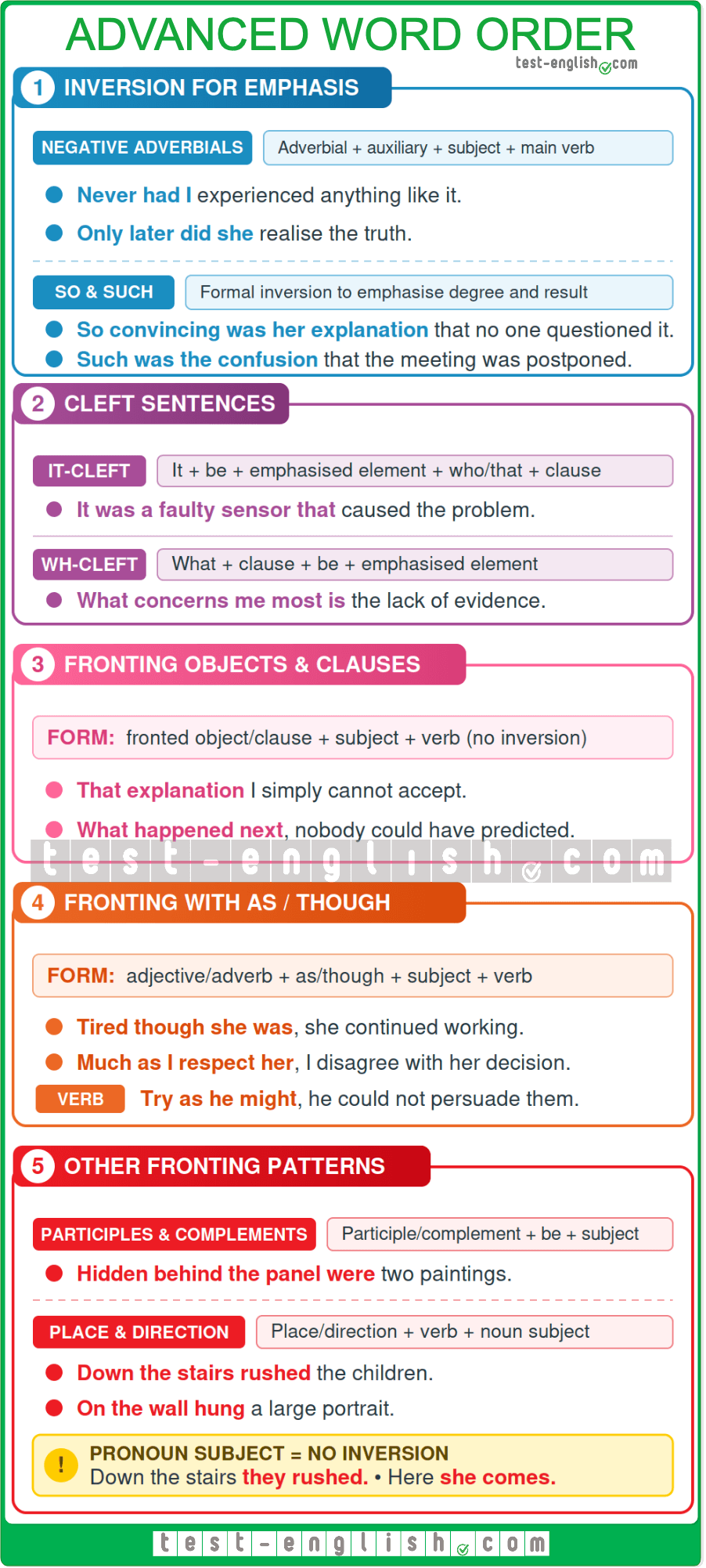
Here’s a grammar chart to help you remember how to use inversion, cleft sentences and fronting.
Download full-size image from Pinterest

-

Download lessons and tests as PDFs
Upgrade to PRO for printable PDFs and a more personalised learning experience.
- PDFs for every lesson and test
- An ad-free experience
- Progress tracking
- Skill badges
- Learner leaderboards

Watch the one-minute PRO overview
Exercises
Explanation
Downloads


