-
Advanced comparative structures
In our B2 lesson on comparative structures, we use modifiers such as much, far, a lot, slightly and a little to express degrees of difference. We also use expressions such as nowhere near as, not quite as and by far the most. In this lesson, we will extend these patterns with more formal, precise and structurally complex ways of comparing.
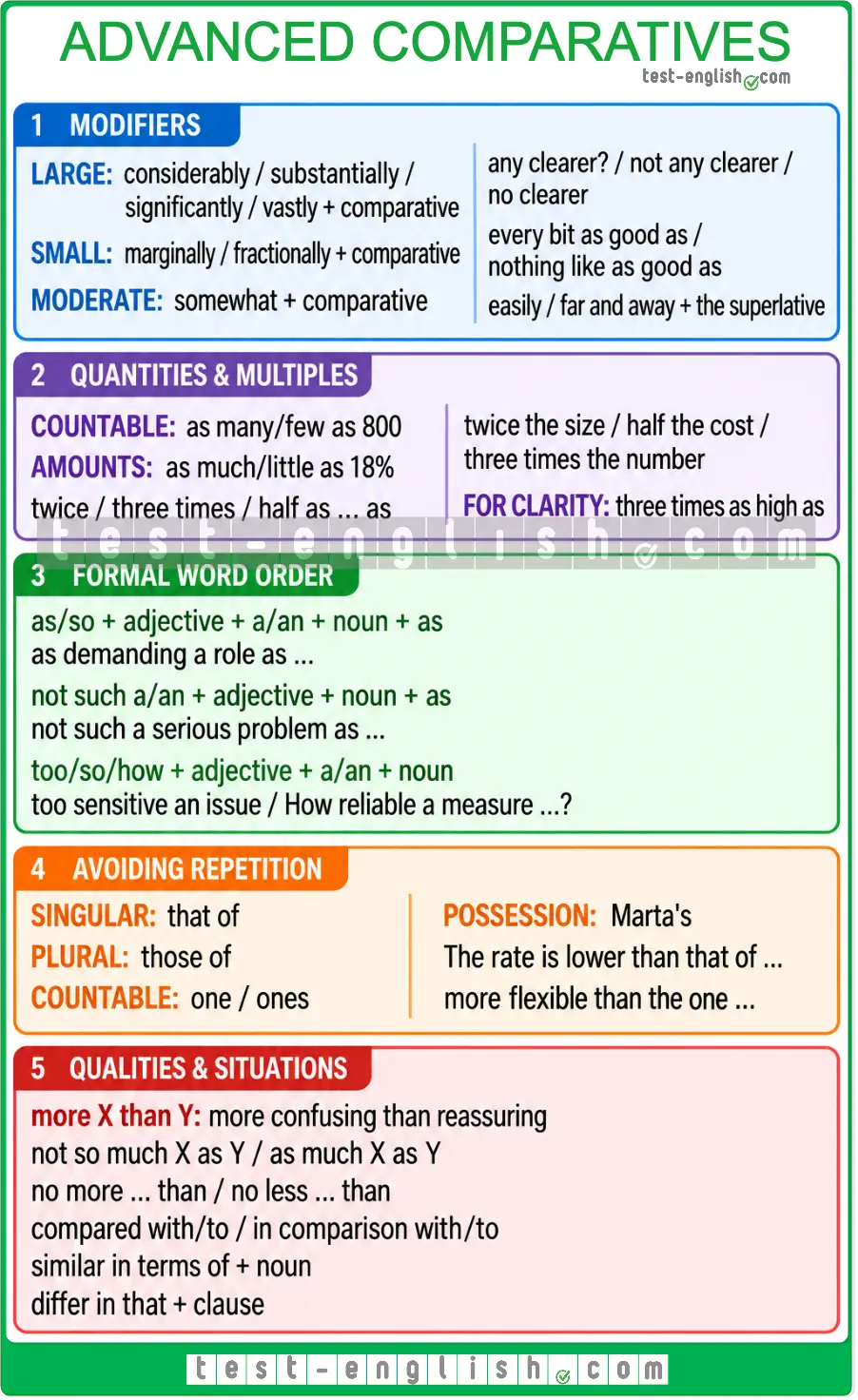
The chart below summarises the main advanced comparative structures covered in this lesson.
Download full-size image from Pinterest
Formal and emphatic modifiers
Expressing large, moderate and small differences
In formal or academic English, we often use considerably, substantially, significantly or vastly for large differences. Marginally and fractionally describe very small differences, while somewhat makes a comparison more cautious or moderate.
- The revised estimate was substantially lower than the original one.
- Participants completed the second task significantly more quickly than the first.
- Demand was only marginally higher than expected.
Any and no with comparatives
We commonly use any before a comparative in questions and negative sentences. No can be used in an affirmative sentence with the same emphatic negative meaning.
- Is the updated guidance any clearer?
- The replacement part is not any easier to install.
- The replacement part is no easier to install.
Emphasising similarity, difference and superlatives
Every bit as … as emphasises that two things are equal, while nothing like as … as means that one is much less than the other. We can emphasise superlatives with easily or far and away.
- The smaller venue was every bit as impressive as the main hall.
- The procedure was nothing like as straightforward as the instructions suggested.
- This is far and away the most convincing explanation.
Numerical and quantity comparisons
Unexpected quantities
We use as many as and as few as with countable nouns to emphasise that a number is surprisingly large or small. We normally use as much as and as little as with amounts, percentages and distances.
- As many as 800 applications were submitted in one day.
- The error affected as few as twelve customers.
- Prices increased by as much as 18 per cent in some areas.
Multiples and fractions
For exact numerical comparisons, we can use twice, three times, half, etc. before as + adjective/adverb + as. With nouns, we can use expressions such as twice the size of, half the cost of or three times the number of.
- The new venue can accommodate three times as many spectators as the old one.
- The revised procedure takes half as long as the previous one.
- The northern site occupies twice the area of the southern site.
🔍 For precise comparisons, forms such as three times as high as or three times the level of are clearer than three times higher than, which may be interpreted in different ways.Advanced word order in comparisons
With a singular countable noun, we can place the adjective before a/an + noun in the structure as/so + adjective + a/an + noun + as. This pattern is particularly common in formal English.
- It was as demanding a role as she had expected.
- This is not so straightforward a procedure as it may appear.
We can also use not such a/an + adjective + noun + as with a similar meaning.
- It was not such a serious discrepancy as we had initially thought.
The same adjective position occurs in the related formal patterns too/so/how + adjective + a/an + noun.
- This is too sensitive an issue to discuss publicly.
- How reliable a measure is it?
Avoiding repetition in comparisons
In formal English, we can use that or those instead of repeating a noun. We use that for a singular noun and those for a plural noun, often followed by of.
- The unemployment rate is lower than that of the neighbouring region.
- The latest findings are more reliable than those of earlier studies.
We can use one/ones for countable nouns and a possessive form when the repeated noun belongs to a person or organisation.
- We need a more flexible arrangement than the one currently in place.
- Our proposal is considerably more detailed than Marta’s.
Comparing qualities and situations
Comparing two descriptions
We can use more … than to say that one description is more accurate than another. Not so much … as corrects or replaces the first description, while as much … as presents both descriptions as equally appropriate.
- The announcement was more confusing than reassuring.
- The delay was not so much a technical failure as a planning error.
- Her response was as much a warning as an invitation.
No more … than means ‘not to a greater degree than’ and often implies that neither description is true. No less … than emphasises that something is equally true or important.
- The revised policy is no more effective than the one it replaced.
- The financial risk is no less serious than the legal risk.
Formal comparison of situations
Compared with/to and in comparison with/to introduce the person, thing or situation used as a point of comparison. We can use similar in terms of + noun to identify a shared feature, and differ in that + clause to explain a difference.
- Compared with last year’s figures, the latest results are encouraging.
- The two schemes are similar in terms of cost but differ in that only one covers maintenance.

Exercises
Explanation
Downloads