-
Subject–verb agreement: Advanced rules
A singular subject normally takes a singular verb, while a plural subject takes a plural verb. Agreement can become less obvious when the subject is a long phrase, follows the verb, or has a grammatical form that conflicts with its meaning.
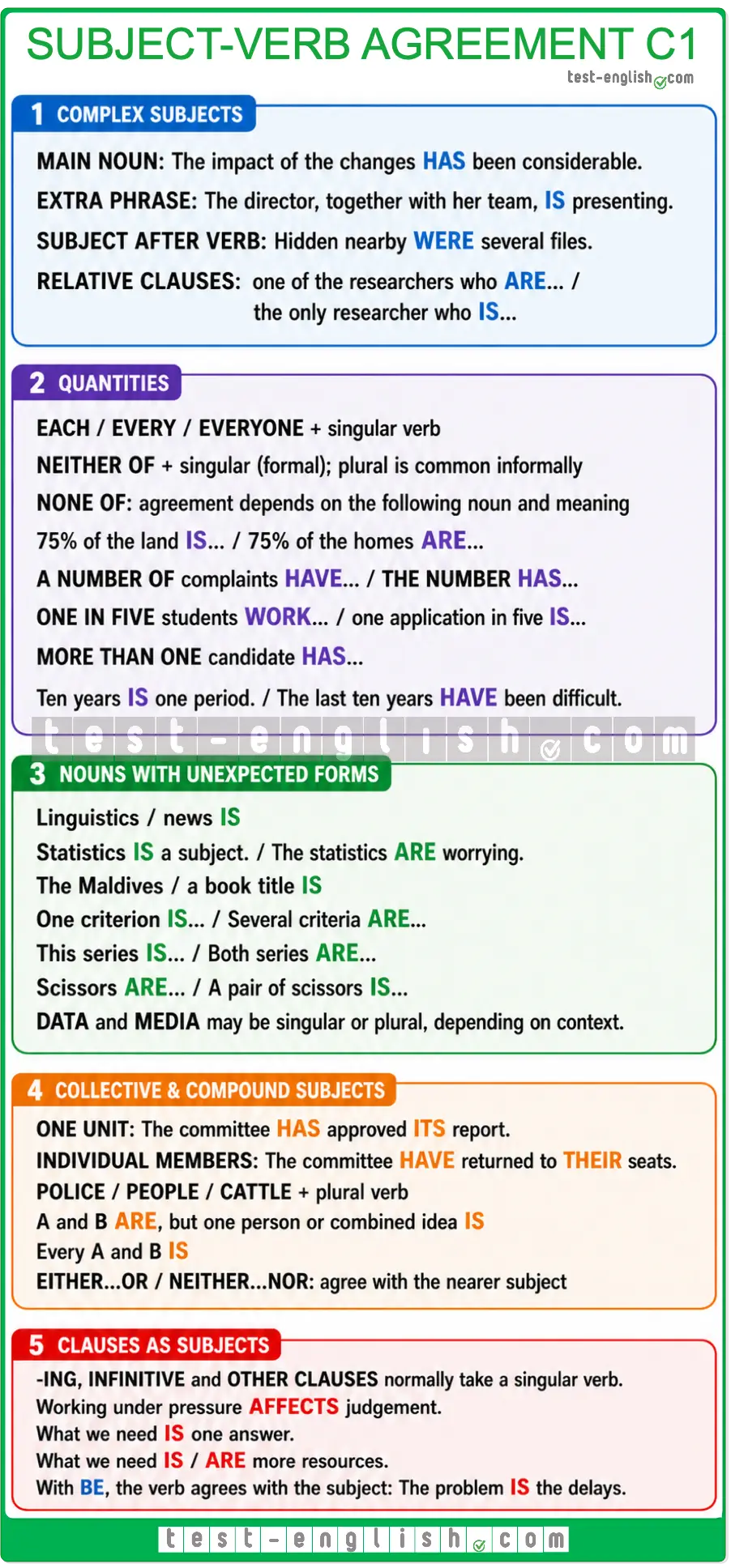
The chart below summarises the main subject–verb agreement rules covered in this lesson.
Download full-size image from Pinterest
Agreement in complex sentences
Finding the main noun
In a long noun phrase, the verb agrees with the main noun, not with a nearer noun.
- The impact of the recent changes has been considerable.
- The proposals submitted by the advisory panel are being considered.
Expressions such as as well as, together with, along with and in addition to do not form a plural subject. The verb agrees with the noun before the expression. By contrast, subjects joined by and normally take a plural verb.
- The chief researcher, together with her assistant, is presenting the findings.
- The chief researcher and her assistant are presenting the findings.
When the subject follows the verb
In inverted structures and sentences beginning with there, the verb still agrees with the subject that follows it.
- Hidden beneath the floorboards were several confidential documents.
- At the centre of the dispute is a clause that neither side had noticed.
- There appear to be several problems with the figures.
💡 In informal speech, there’s is often used before a plural noun. In formal writing and examinations, use there are: There are several issues to resolve.Agreement in relative clauses
The verb in a relative clause agrees with the person or thing that the relative pronoun refers to.
- Leila is one of the researchers who are investigating the leak. (who refers to researchers)
- Leila is the only researcher who is investigating the leak. (who refers to the only researcher)
Quantities and indefinite expressions
Each, every, either, neither and none
We use a singular verb after each, every, everyone, everybody and everything, even when gender-neutral they or their is used later.
- Each of the proposals requires further discussion.
- Everyone has submitted their report.
Either and neither take a singular verb before a singular noun. In careful formal writing, either of and neither of are also generally singular, although plural agreement is common in informal English.
- Neither of the suggested solutions is entirely satisfactory. (more formal)
- Neither of my colleagues are available today. (informal)
With none of, we normally use a singular verb with an uncountable noun and often a plural verb with a plural countable noun. A singular verb can emphasise the meaning ‘not one’.
- None of the equipment was damaged.
- None of the witnesses were prepared to testify.
- None of the witnesses was prepared to testify. (more formal; not one witness)
Fractions, percentages and proportions
With fractions, percentages and expressions such as most of, the majority of and a proportion of, the verb normally agrees with the noun after of.
- Nearly three quarters of the coastline is protected.
- Nearly three quarters of the coastal villages are at risk.
One in five + plural noun commonly takes a plural verb when the focus is on the group, but singular agreement is possible when the emphasis is on one individual or item.
- One in five graduates work abroad.
- One in every five applications is rejected.
A number of, the number of and measurements
A number of + plural noun means ‘several’ and takes a plural verb; the number of + plural noun refers to one figure and takes a singular verb. Despite its plural meaning, more than one + singular noun also normally takes a singular verb.
- A growing number of residents have objected to the development.
- The number of formal complaints has fallen considerably.
- More than one candidate has withdrawn.
A plural expression denoting an amount, distance, period or measurement normally takes a singular verb when considered one unit. We use a plural verb when thinking of separate units.
- Six months is a remarkably short time to redesign the network.
- The last three years have been particularly difficult.
Nouns with unexpected forms
Nouns ending in -s
Some nouns ending in -s have a singular meaning and take a singular verb. These include certain subjects, activities, illnesses and news. Others change their agreement according to their meaning.
- Linguistics is taught as part of the degree.
- Statistics is compulsory, but the latest statistics are worrying.
Names of countries, organisations, books, films and other works normally take a singular verb when they refer to one entity.
- The Maldives is particularly vulnerable to rising sea levels.
- Crossing Borders is her latest documentary.
Irregular and unchanged plurals
Some Greek and Latin nouns have irregular plurals, such as criterion–criteria, phenomenon–phenomena, analysis–analyses and hypothesis–hypotheses. Nouns such as means, species and series have the same singular and plural form. In both cases, agreement depends on whether the noun is singular or plural.
- None of the proposed criteria are easy to measure.
- This series of lectures has attracted considerable interest.
- Both series have now been made available online.
Plural-only nouns, data and media
Names of two-part objects such as trousers, glasses, scissors and tweezers take a plural verb, but a pair of takes a singular verb.
- These scissors aren’t sharp, but this pair of scissors is suitable.
Data traditionally takes a plural verb, which remains common in scientific writing. It is also widely treated as an uncountable noun with a singular verb. Media is often plural when it means news organisations, while social media can be treated as a single system.
- The data are consistent with the hypothesis. / The data is stored securely.
- The media have shown interest in the case. / Social media has transformed campaigning.
Collective nouns
In British English, collective nouns such as committee, government, audience, family, staff and team can take either a singular or plural verb. We use singular agreement when the group is considered one unit and plural agreement when the focus is on its members. Pronouns should agree with this choice.
- The committee has approved its final report. (one body)
- The committee have returned to their seats. (individual members)
💡 In American English, collective nouns are more commonly singular. To focus on individuals, speakers often use expressions such as the committee members or the players on the team.Some group nouns, particularly police, people and cattle, normally take plural verbs. Sports team names can take singular or plural agreement depending on whether we mean the organisation or its players.
- The police are investigating the disappearance.
- Westbridge United is owned by an investment group. (the organisation)
- Westbridge United are celebrating their third goal. (the players)
Compound subjects and clauses
Subjects joined by and
Subjects joined by and normally take a plural verb. We use singular agreement when two descriptions refer to one person or the nouns form one combined idea. A repeated determiner can show that two people are meant.
- The founder and chief executive is addressing the staff. (one person)
- The founder and the chief executive are addressing the staff. (two people)
- Research and development is central to the company’s strategy. (one activity)
When each or every comes before singular subjects joined by and, we normally use a singular verb.
- Every desk and chair was removed from the room.
Either…or and neither…nor
Two singular subjects joined by either…or or neither…nor generally take a singular verb in careful writing. If one subject is singular and the other plural, the verb normally agrees with the nearer one. Rewrite the sentence if the result sounds awkward.
- Neither the technicians nor the supervisor was aware of the fault.
- Neither the supervisor nor the technicians were aware of the fault.
Clauses as subjects
An infinitive clause, an -ing clause or another clause used as the subject normally takes a singular verb.
- Working under constant pressure affects people’s judgement.
- Whether the figures can be trusted remains unclear.
A what-clause normally takes a singular verb before a singular complement. Before a plural complement, singular and plural agreement are possible: singular agreement treats the clause as one idea, while plural agreement anticipates the complement and is often preferred in formal contexts.
- What eventually persuaded the committee was a previously overlooked email.
- What caused the greatest difficulty was the last-minute changes.
- What caused the greatest difficulty were the last-minute changes. (more formal)
In ordinary sentences with be, the verb agrees with the subject, not the complement.
- The main problem is the repeated delays.

Exercises
Explanation
Downloads