-
Idiomatic infinitive phrases – C1 English Vocabulary
In this Advanced Vocabulary lesson, you will learn common idiomatic infinitive phrases used to express opinions, clarify ideas, add emphasis, and organise information in spoken and written English. Check the explanation to familiarize yourself with the expressions before doing the exercises.
Exercise 1
Choose the correct option for each gap.
-
Idiomatic infinitive phrases – C1 English Vocabulary
In this Advanced Vocabulary lesson, you will learn common idiomatic infinitive phrases used to express opinions, clarify ideas, add emphasis, and organise information in spoken and written English. Read the definitions and example sentences to learn how these phrases are used naturally.
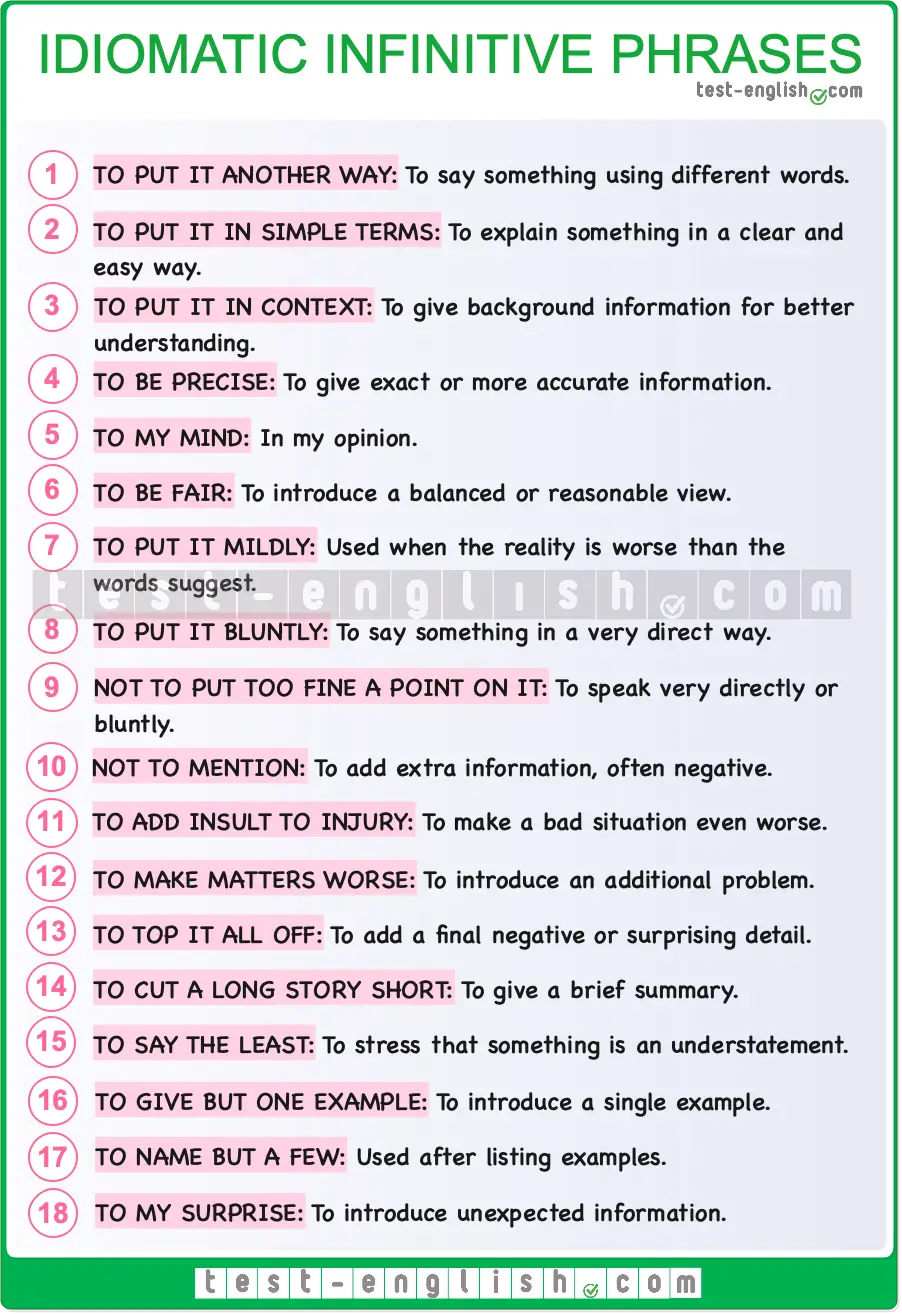
Rephrasing and clarifying ideas
1 To put it another way: to say something using different words.
- To put it another way, the policy failed to achieve its aims.
2 To put it in simple terms: to explain something in an easy and direct way.
- To put it in simple terms, demand is higher than supply.
3 To put it in context: to give background information so something is better understood.
- To put it in context, these changes began over a decade ago.
4 To be precise: to give exact or more accurate information.
- The project will cost two million euros, to be precise.
Expressing opinion and stance
5 To my mind: in my opinion.
- To my mind, stricter regulation is necessary.
6 To be fair: to express a balanced or reasonable view.
- To be fair, the company responded quickly.
Being direct or diplomatic
7 To put it mildly: used when the reality is worse than the words suggest.
- The service was disappointing, to put it mildly.
8 To put it bluntly: to say something in a very direct way.
- To put it bluntly, the plan is unrealistic.
9 Not to put too fine a point on it: to be direct, to speak bluntly.
- Not to put too fine a point on it, the system is broken.
Adding information and consequences
10 Not to mention: used to add extra information, often something negative.
- The job involves long hours, not to mention frequent travel.
11 To add insult to injury: to make a bad situation even worse.
- To add insult to injury, no apology was offered.
12 To make matters worse: to introduce an additional problem.
- To make matters worse, funding was cut.
13 To top it all off: to add a final negative or surprising detail.
- To top it all off, the deadline was moved forward.
Summarising and concluding
14 To cut a long story short: to give a brief summary.
- To cut a long story short, the project failed.
15 To say the least: used to emphasise that something is an understatement.
- The response was disappointing, to say the least.
Giving examples
16 To give but one example: to introduce a single example.
- To give but one example, some children earn millions online.
17 To name but a few: used after listing examples.
- Loss of privacy and online harassment, to name but a few.
Expressing reaction
18 To my surprise: used to show unexpected information.
- To my surprise, many parents support the practice.
FlashcardsAfter completing the exercises in this lesson on Infinitive Phrases, you can use the unit’s Vocabulary Flashcards to revise and help you memorize the terms.

-

Download lessons and tests as PDFs
Upgrade to PRO for printable PDFs and a more personalised learning experience.
- PDFs for every lesson and test
- An ad-free experience
- Progress tracking
- Skill badges
- Learner leaderboards

Watch the one-minute PRO overview
Exercises
Explanation
Downloads